_edited.png)
Political Direct Mail Costs: The 2026 Campaign Budgeting Guide

Updated: May 19
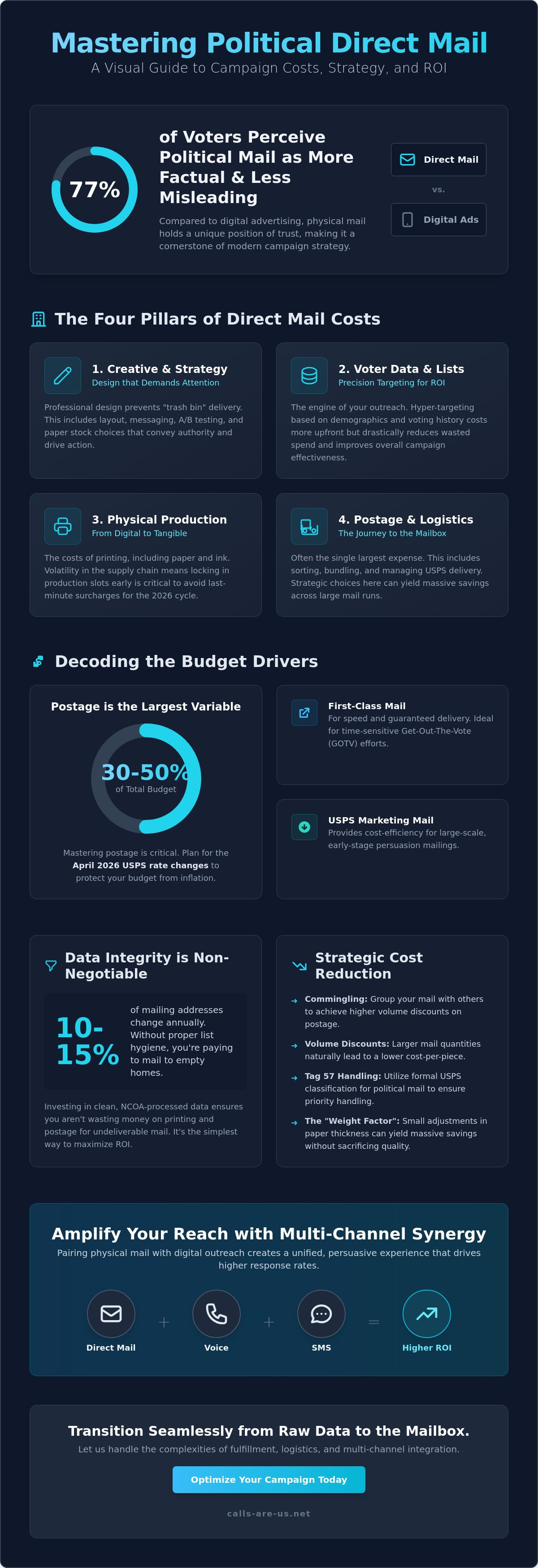
Did you know that 77% of voters perceive political mail as more factual and less misleading than digital advertising? This enduring trust makes physical outreach a cornerstone of modern strategy, yet many campaigns struggle to pin down their actual political direct mail costs before the first piece hits a mailbox. You've likely felt the anxiety of unpredictable postage hikes, the frustration of hidden design fees, and the challenge of measuring physical ROI compared to digital channels. It's a high-stakes environment where every dollar must drive a meaningful connection. We believe that effective communication is the heartbeat of a healthy democracy, and we're here to help you navigate these complexities with the precision of a seasoned partner.
We understand that managing a multi-channel budget feels like a constant balancing act between reach and resources. This guide provides the clarity you need to master the variables of campaign mail pricing while ensuring your message lands with maximum impact. You'll learn to anticipate the April 2026 USPS rate changes, implement strategies to reduce cost-per-piece, and account for the 10-15% of addresses that change annually. From leveraging Tag 57 priority handling to utilizing specific USPS promotions, we'll show you how to turn a traditional medium into a data-driven powerhouse that respects your bottom line and integrates seamlessly with your broader outreach efforts.
Key Takeaways
Identify the four structural pillars of campaign budgeting to ensure your creative and data investments translate into tangible voter influence.
Master the 2026 USPS postage landscape to eliminate hidden fees and accurately forecast your political direct mail costs across every mailing tier.
Amplify your campaign's reach by pairing physical mail with voice and SMS outreach. This creates a unified and persuasive voter experience that drives higher response rates.
Leverage logistics techniques like commingling and volume discounts to reduce your cost per piece while maintaining high delivery standards.
Transition seamlessly from raw data to the mailbox with integrated fulfillment solutions that simplify your workflow and respect your timeline.
Table of Contents
The Four Pillars of Political Direct Mail Costs
Direct mail is a strategic investment in voter trust. It isn't a single invoice; it's a composite of four distinct pillars that must work in harmony. Understanding the political usage of direct mail requires looking beyond the stamp. We break these expenses down into creative strategy, physical production, logistical handling, and data acquisition. Each pillar influences your final political direct mail costs. Optimizing these variables ensures your message reaches the kitchen table rather than the recycling bin.
Design is your first impression. A professional layout prevents "trash bin" delivery by capturing attention in the three seconds it takes a voter to walk from the mailbox to the front door. It's not just about aesthetics; it's about visual hierarchy, clear messaging, and urgent calls to action. The tactile feel of a mailer also communicates authority. Your choice of paper stock and ink coverage creates a physical weight that digital ads simply cannot replicate. Heavier cardstock or high-gloss finishes signal a serious candidacy, while efficient ink usage can help manage the production budget.
Logistics and data form the backbone of a successful run. Getting the mailer from the press to the porch involves a complex sequence of sorting, bundling, and managing the "last mile" delivery through the USPS. Simultaneously, the quality of your voter list determines your efficiency. We believe that precision is the ultimate cost-saver. By identifying the right audience through sophisticated data modeling, you ensure that every printed piece has a purpose and a destination.
Creative and Strategic Design Fees
Precision matters in messaging. Many agencies offer flat-rate design packages, which provide budget certainty for standard postcards. Others prefer hourly billing for intensive strategic work that involves deep research. If you choose complex formats like folded self-mailers, expect your design fees to increase. These layouts require specific templates to ensure USPS machines process them without damage. Strategic fees often encompass more than just graphics; they include message testing, A/B variations, and psychological triggers designed to move specific voter blocks.
Voter Data and List Acquisition
Data is the engine of your outreach. You can utilize your own "house list" of previous donors or rent voter files from specialized brokers. While broad lists are less expensive, they often result in significant wasted spend. Hyper-targeting based on demographics, voting history, and local issues increases data costs but improves your overall ROI. Investing in clean, NCOA-processed data ensures you aren't paying to print and ship mailers to residents who have moved. This level of accuracy keeps your political direct mail costs manageable while maximizing the significance of every interaction.
Decoding Printing and Postage: The 2026 Budget Drivers
Postage is the single largest variable in your outreach strategy. It often commands between 30% and 50% of your total budget. Mastering these expenses requires a firm grasp of the April 26, 2026, USPS rate changes. While First-Class Mail offers speed and guaranteed delivery for urgent Get-Out-The-Vote (GOTV) efforts, USPS Marketing Mail provides the cost-efficiency needed for early-stage persuasion. Choosing the right class isn't just about delivery times; it's about protecting your political direct mail costs from unnecessary inflation. We believe that every cent saved on logistics is a cent earned for your message's reach.
Supply chain volatility remains a critical factor for the 2026 cycle. Paper prices and ink availability fluctuate based on global demand and logistical bottlenecks. We recommend securing your production slots early to lock in materials and avoid last-minute surcharges. Weight also plays a pivotal role in your financial planning. Moving from a standard postcard to a heavier stock can push your mailer into a higher price tier. This "Weight Factor" means that even a fraction of an ounce can significantly alter your per-piece rate. Small adjustments in paper thickness can yield massive savings across a 50,000-piece run.
USPS Classes and Political Rates
Visibility is vital during a crowded election season. The USPS formally classifies political mail for priority handling and requires the use of "Tag 57" to ensure your mail moves through the system promptly. For a deep dive into these classifications, consult the USPS guide to political mail formats to understand which tier fits your strategy. While non-profit rates offer substantial savings for qualified organizations, most campaigns will operate under standard commercial rates. If you're targeting a specific geographic area without the need for individual voter data, Every Door Direct Mail (EDDM) remains a low-cost alternative for broad saturation.
Printing Variables: Digital vs. Offset
Technology dictates your production efficiency. Digital printing is the gold standard for small, highly personalized runs that utilize variable data to speak directly to a voter's concerns. Conversely, offset printing becomes the more economical choice once your volume exceeds 10,000 pieces. You can further reduce overhead through "gang printing," where multiple campaigns share the same press run to split setup fees. Adding special coatings like UV or aqueous finishes increases durability and prevents scuffing during transit. These small additions add cents to each piece but ensure your message arrives in pristine condition. For those looking to maximize their impact, integrating these physical touchpoints with digital follow-ups creates a persuasive voter experience that resonates long after the mail is opened.
The ROI Equation: Comparing Mail to Digital and Multi-Channel
Direct mail isn't just an expense; it's a high-yield asset. While digital impressions are cheaper on a per-unit basis, mail delivers a "tangibility premium" that justifies the initial political direct mail costs. This is backed by voter sentiment; 77% of surveyed gubernatorial voters in 2025 said they perceive political mail to be more factual than other advertising channels. This trust translates into higher response rates and more reliable voter turnout. To see how these variables balance out, consulting a 2026 political direct mail cost guide can help you benchmark your spend against industry standards.
We believe in the power of the "Surround Sound" effect. A single mailer is effective, but its impact multiplies when it's paired with political voice broadcasting. This multi-touch approach ensures that your message isn't just seen; it's heard and felt. You can bridge the physical-digital divide by incorporating QR codes or vanity URLs. These tools provide the attribution data needed to track spend accurately. They turn a traditional medium into a measurable digital gateway, allowing you to justify your political direct mail costs through hard data. Since 92% of political consultants state that direct mail is an effective channel, the goal is to optimize that effectiveness through smart integration.
Direct Mail vs. Digital Ad Spend
Digital saturation has reached a tipping point. While the CPM for social media ads remains lower than physical mail, the physical presence of a postcard offers a deeper connection. A mail piece stays in the home for days, often resting on a counter or fridge where it's seen multiple times. Digital ads vanish with a single swipe. We've seen that digital-only campaigns face diminishing returns as voters grow fatigued by screen-based messaging. Physical mail breaks through this noise by offering a tactile experience that feels more personal and permanent.
Multi-Channel Synchronization
Efficiency comes from integration. You can use direct mail to "warm up" a household before deploying a broader mass communication strategy. This sequence builds familiarity and trust. For instance, sharing the same targeted data file between your P2P texting and direct mail efforts ensures a unified budget. This synchronization reduces your overall "cost per touch" by reinforcing the same message across physical and digital platforms. Personalization is crucial here; 90% of surveyed voters agree it's important for mail pieces to speak to them personally on the issues they care about most. When your mailers, texts, and calls all sing from the same songbook, your campaign achieves a level of significance that a siloed approach can't match.
Strategic Optimization: How to Lower Your Cost Per Piece
Strategy is the ultimate equalizer in a high-stakes election. While postage rates are fixed by the USPS, your logistical choices determine the final efficiency of your spend. Managing political direct mail costs requires a keen eye for volume thresholds and format specifications. For example, the 10,000-piece mark represents a critical shift in production value. At this level, the transition from digital to offset printing begins to yield significant per-unit savings. We've seen that a 50,000-piece run can cost between 25% and 35% less per piece than a smaller 5,000-piece mailing. This scalability allows larger campaigns to saturate markets with a level of efficiency that smaller operations struggle to match.
Precision in format is equally vital for your bottom line. A simple 1/4 inch mistake in dimensions can inadvertently push a mailer from the "letter" category into the "flat" category. This error can double your postage expense overnight. Beyond size, logistical maneuvers like drop-shipping and commingling offer sophisticated ways to bypass USPS hubs. By delivering mail directly to a Sectional Center Facility (SCF) or a Destination Delivery Unit (DDU), you reduce the number of times the USPS handles your pieces. This doesn't just save money; it improves the reliability of your delivery window. To maximize these savings, you can streamline your direct mail operations through our integrated fulfillment platform.
The Logistics of Mail House Efficiency
Clean data is the foundation of a lean budget. Since an estimated 10% to 15% of addresses change annually, National Change of Address (NCOA) scrubbing is essential to prevent "dead mail" waste. We also recommend targeting specific "in-home" dates to avoid peak delivery surcharges during the final weeks of the cycle. For national or statewide campaigns, co-palletization allows you to combine shipments with other mailers. This shared transport reduces the cost of moving pallets to regional postal entries, ensuring your political direct mail costs remain competitive even at scale.
Union Printing and Compliance
The "Union Bug" is more than a budget line item; it's a badge of political alignment. Many party endorsements require the use of union-certified shops, which can add a 5% to 15% premium to your printing costs. You must budget for this early to avoid last-minute financial strain. Compliance is another non-negotiable factor. Federal Election Commission (FEC) regulations require all public political communications to display a clear and conspicuous disclaimer. These must identify who paid for the piece and whether it was authorized by a candidate. Missing these details can lead to heavy fines that far outweigh any initial savings on production.
Fulfillment Excellence with Calls-Are-Us
Excellence in fulfillment is the bridge between a strategic plan and a persuaded voter. We simplify the transition from complex datasets to physical mailboxes by providing a direct, streamlined path to production. This approach eliminates the friction often found in traditional agency models. It ensures that your political direct mail costs are dictated by market rates and logistical efficiency rather than hidden markups. Whether you're managing a local school board race or a national ballot initiative, our scalable infrastructure adapts to your specific volume requirements with precision and speed.
Transparency is the foundation of our partnership. We provide clear, itemized reporting that allows you to see exactly where every dollar is working. We believe that an empowered campaign is an effective campaign. By removing the "black box" of traditional mail houses, we give you the tools to optimize your budget in real-time. This commitment to honesty ensures that your resources are focused on what matters most: connecting with voters and winning on election day. We provide the tools, the technology, and the transparency you need to lead with confidence.
A Multi-Channel Approach to Voter Contact
Outreach is most effective when it's multi-dimensional. We provide a holistic ecosystem where your direct mail services live alongside our live calling center, IVR systems, and Voice Broadcast tools. This integration allows you to manage a single, high-quality data list across multiple channels. It ensures your message is consistent, your brand is recognizable, and your budget is utilized with maximum efficiency. We focus on high-stakes authority and ethical communication, helping you champion a philosophy of open dialogue. By combining the tactile nature of mail with the immediacy of peer-to-peer texting and mass texting, you create a persuasive environment that resonates across all demographics.
Getting Started with Your 2026 Mail Strategy
Success in the 2026 cycle requires foresight and preparation. Early planning is the only way to lock in paper supplies and secure press time before the inevitable election-year rush. We invite you to request a comprehensive quote that accounts for all four cost pillars: creative, production, logistics, and data. This proactive approach helps you avoid the "last-minute premium" and protects your political direct mail costs from market volatility. Let's build a strategic partnership that transforms your outreach goals into measurable impact. Contact us today to begin crafting a unified strategy that bridges the gap between digital speed and physical trust.
Move Forward with a Data-Driven 2026 Strategy
Precision is the hallmark of a winning campaign. We've explored how mastering the four pillars and navigating the 2026 USPS landscape allows you to control your political direct mail costs without sacrificing the quality of your voter connections. By integrating physical mail with digital and voice outreach, you create a "surround-sound" effect that builds trust and drives action. This strategic synchronization ensures your message is heard, felt, and remembered across every household in your district.
We bring the weight of seasoned expertise to your side. As multi-channel integration experts who have operated in over 40 states, we provide the scalable outreach and technical precision required for any campaign size. We help you transform raw data into meaningful interactions while maintaining total transparency in your budgeting. Optimize your 2026 campaign budget with Calls-Are-Us fulfillment and ensure every mailer, call, and text works toward a unified victory. Your vision for social progress deserves a platform that is as principled as it is powerful. Let's build that connection together.
Frequently Asked Questions
What is the average cost per piece for a political postcard in 2026?
Industry benchmarks suggest an all-in cost ranging from $0.40 to $0.85 per piece depending on your total volume and specifications. For a standard 6x9" postcard at quantities of 10,000 or more, you can expect political direct mail costs to settle between $0.40 and $0.50 per piece. These figures encompass the four critical pillars of design, data, production, and postage.
Does the USPS offer special postage rates for political campaigns?
The USPS provides priority handling for political mail but doesn't offer a specific discounted rate solely for candidates. Most campaigns utilize USPS Marketing Mail rates, which as of April 2026, are $0.372 for 5-digit automation letters and $0.407 for AADC automation letters. You must use "Tag 57" to ensure your materials receive expedited processing during the busy election cycle.
How does the size of my mailing list affect the overall cost?
Larger mailing lists significantly lower your per-piece expenses because they allow you to leverage economies of scale in printing and sorting. A 50,000-piece run can cost 25% to 35% less per piece than a smaller 5,000-piece mailing. This volume allows you to amortize fixed setup fees across a much broader base, which directly optimizes your total outreach budget.
Is it cheaper to use a union printer for my campaign mailers?
Union printing typically carries a price premium of 5% to 15% compared to non-union shops. While this increases the production budget, the "union bug" is often a mandatory requirement for specific party endorsements or labor-aligned outreach. You should weigh this financial investment against the strategic value of the endorsement it helps secure before finalizing your vendor choice.
Can I save money by using Every Door Direct Mail (EDDM) instead of targeted mail?
EDDM is significantly cheaper for postage, with 2026 retail rates remaining at $0.247 per piece. However, you sacrifice the ability to target specific voters based on their demographics or voting history. It's an excellent tool for broad saturation in local districts, but it often results in higher waste compared to data-driven, targeted mailings that reach specific households.
How much should I budget for professional design and copywriting?
Design fees vary based on the complexity of the mailer and whether you choose flat-rate packages or hourly strategy consulting. Professional design is a vital investment because it ensures your message captures attention in the three seconds it takes a voter to check their mail. High-quality creative prevents "trash bin" delivery and justifies the overall political direct mail costs by driving higher engagement.
What are the hidden costs I should look for in a mail house quote?
Watch for undisclosed fees related to data list processing, NCOA scrubbing, and palletization. Some quotes may omit "last mile" delivery surcharges or the costs for variable data printing, which typically adds $0.01 to $0.03 per piece. Requesting a comprehensive breakdown of every production and fulfillment step ensures you aren't surprised by unexpected invoices during the final weeks of the campaign.
How does direct mail ROI compare to peer-to-peer texting?
Direct mail offers a higher trust factor and longer shelf life, while peer-to-peer texting provides immediate engagement and lower entry costs. Survey data from 2025 shows that 77% of voters trust the authenticity of mail more than digital advertising channels. We believe a multi-channel approach is best; use mail to establish authority and texting to drive urgent, real-time voter turnout.



Comments