
Crafting a Winning Voter Persuasion Script: The 2026 Strategy Guide

Updated: Jun 18
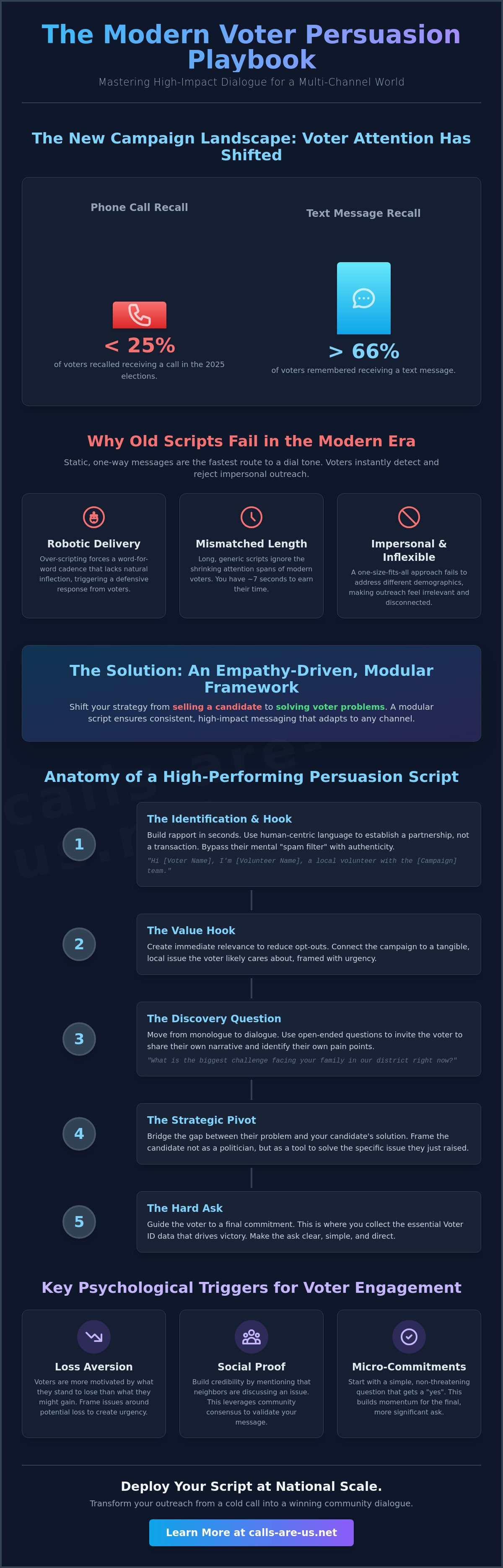
In the 2025 gubernatorial elections, fewer than a quarter of voters recalled receiving a phone call, while over two-thirds remembered receiving a text. This massive shift in attention means your voter persuasion script can no longer rely on the rigid, one-size-fits-all approach of the past. You likely feel the sting of low response rates and the awkward silence of a volunteer who sounds more like a machine than a neighbor. It's a common frustration, especially when high opt-out rates on text campaigns threaten to derail your outreach before it even starts.
We believe that effective communication is the heartbeat of any winning campaign. This guide promises to help you master the art of political dialogue with a modular template designed for high-impact, multi-channel engagement. You'll discover how to build a scalable messaging framework that works for both phone and text, ensuring consistent messaging across your entire team. We will break down the essential components of a modern script, examine the impact of recent FCC rulings on AI voices, and provide a clear roadmap for collecting the voter ID data that drives victory.
Key Takeaways
Shift your strategy from selling a candidate to solving voter problems to increase engagement in a noisy digital environment.
Master a modular voter persuasion script template that ensures consistent, high-impact messaging across peer-to-peer texting and live call centers.
Use the "Value Hook" technique to create immediate relevance and reduce the high opt-out rates that often derail outreach.
Deploy Interactive Voice Response (IVR) and voice broadcasting to scale your message while maintaining precise data collection for voter ID.
Implement an empathy-driven framework to build trust, ensuring your volunteers don't sound robotic or disconnected during high-stakes interactions.
Table of Contents
The Science of Persuasion in 2026 Political Communication
Persuasion is no longer a monologue. In an environment where voters face constant digital stimulus, a static, one-way message is the fastest route to a dial tone. You have exactly seven seconds to secure your permission to persuade. This isn't about reciting a list of accomplishments; it's about establishing a human connection that feels immediate, relevant, and sincere. To succeed, your team must pivot from selling a candidate to solving a voter’s specific pain points.
To better understand this concept, watch this helpful video:
A modern voter persuasion script functions as a living document. It shouldn't be a rigid block of text that forces volunteers into a robotic cadence; it should act as a flexible framework that allows for real-time adjustments. When you move voters from passive listening to active engagement, you're not just delivering a message. You are inviting them into a conversation about their own community. Your script must empower volunteers, influence undecideds, and win the district through authentic dialogue.
Why Generic Scripts Fail in Modern Campaigns
Over-scripting creates a robotic trap that voters detect instantly. When a volunteer reads a script word-for-word, the lack of natural inflection triggers a defensive response in the listener. Many campaigns also suffer from a mismatch between script length and the shrinking attention spans of 2026. A generic script lacks the modularity needed to address different demographics, which makes the outreach feel impersonal. High-performing teams use scripts that are brief, adaptable, and focused on the listener's perspective to ensure every interaction feels tailored and significant.
The Psychology of Voter Decision-Making
Successful outreach relies on proven psychological triggers. One of the most effective is the principle of loss aversion. Voters are often more motivated by what they stand to lose than by what they might gain. Framing an issue around a potential loss of local services or community stability creates a sense of urgency. You can also integrate deep canvassing techniques to foster genuine empathy and long-term persuasion through shared stories.
Social proof is another vital tool. By mentioning that neighbors are already discussing a specific issue, you build candidate credibility through community consensus. Finally, use micro-commitments in the first minute. Asking a simple, non-threatening question that gets a "yes" response builds the momentum needed for the final ask. This strategy transforms a cold call into a collaborative interaction that respects the voter's time and autonomy.
Anatomy of an Effective Voter Persuasion Script
A high-performing script is more than a list of talking points; it's a strategic architecture designed to guide a voter through a psychological journey from initial wariness to final commitment. Every successful voter persuasion script relies on a clear, five-part anatomy: the identification phase, the value hook, the discovery question, the strategic pivot, and the hard ask. When these elements align, your outreach transforms from a cold intrusion into a meaningful community dialogue.
The Hook: Building Rapport in Seconds
Connection begins with authenticity. You must bypass the mental "spam filter" that modern voters use to guard their time. Avoid the robotic tone of a debt collector by using human-centric language that emphasizes shared community. "Hi [Voter Name], I'm [Volunteer Name], a local volunteer with the [Campaign Name] team." This simple introduction establishes a partnership rather than a transaction. By understanding the art of political persuasion, you can navigate the early seconds of a call with the authority of a trusted neighbor.
The Pivot: Identifying Core Voter Concerns
Discovery is the engine of persuasion. Instead of lecturing the voter, use open-ended questions that invite them to share their own narrative. "What is the biggest challenge facing your family in our district right now?" This question forces the voter to identify their own pain points, providing you with the exact emotional triggers needed for a successful pivot. Listen actively and use verbal cues like "I hear you" or "That's a valid concern." Once the voter speaks, bridge their priority to your candidate's platform: "It sounds like rising property taxes are your primary concern, which is the exact reason our campaign is focusing on fiscal transparency."
The Ask: Securing a Scalable Commitment
A vague promise is a missed opportunity. Research indicates that a "voter plan" is far more powerful than a simple "voter promise." Ask specific questions about when they will vote, how they will get to the polls, and if they need assistance with registration. This level of detail turns an abstract intention into a concrete action. Integrating these high-touch moments into a cost effective voter outreach plan ensures your resources are focused on the most persuadable segments of the electorate. If you need help managing this volume, the experts at Calls-Are-Us provide the infrastructure to run these scripts at scale. Finish the call by thanking the voter and clearly stating when they can expect to hear from the campaign again.
Modular Scripting for Multi-Channel Outreach
Consistency is the core of conversion. A fragmented message confuses voters, dilutes your impact, and wastes precious resources. To win in 2026, your campaign needs a modular voter persuasion script that maintains a core narrative while adapting to the unique technical constraints of every channel. Whether you are using direct mail to prime the district or following up with digital outreach, the message must feel like a single, continuous conversation.
Brevity is your best ally when deploying political voice broadcasting. Because this medium is often a one-way delivery, the script must lead with a compelling, punchy benefit immediately. It builds on the seven-second rule established earlier, ensuring the voter stays on the line long enough to hear the call to action. This high-volume approach works best when the language is direct, assertive, and deeply relevant to local concerns.
Scripting for Live Agent Call Centers
Human interaction remains the gold standard for deep persuasion. A political campaign call center provides the nuance needed to handle complex rebuttals and build real rapport. We train volunteers to use the "hook-and-elaborate" structure to deliver information in digestible bites, which prevents them from sounding like they're reading a dry lecture. This conversational approach aligns with findings from voter mobilization experiments, which prove that personalized, empathetic messaging is the most effective way to drive turnout. Agents don't just read; they listen, adapt, and collect the precise data points your campaign needs to win.
P2P and Mass Texting: The 2026 Rules
Texting is the front line of modern outreach, but the rules have changed. Compliance in the 10DLC environment is now a prerequisite for persuasion. You must write scripts that avoid "spammy" language, such as excessive capitalization or aggressive buzzwords that trigger carrier filters. A successful P2P voter persuasion script is short, punchy, and mobile-optimized. It should feel like a text from a friend, not a broadcast from a bot.
The most sophisticated campaigns now use a "text-to-call" transition. You can start with a P2P text to gauge interest and identify a voter's primary concern, then follow up with a live call to finalize their voting plan. This multi-channel flow respects the voter's time while providing the human touch necessary for high-stakes decision-making. By scripting the move from mobile to voice, you create a seamless experience that builds trust and authority across every touchpoint.
The Master Voter Persuasion Script Template
Efficiency meets empathy in the 2026 election cycle. A master voter persuasion script is more than a list of talking points; it's a strategic blueprint for high-stakes influence. This template maps the legal and emotional terrain of a conversation, ensuring your team remains compliant while delivering a message that resonates. By following a structured five-step process, you can transform a simple outreach attempt into a powerful moment of voter alignment.
The template begins with a compliant introduction and moves quickly into an empathy hook that acknowledges a local pain point. From there, the discovery phase identifies the voter's specific priorities, which allows the volunteer to deploy a modular persuasion block. Finally, the call to action secures a firm commitment and logs the data necessary for your ground game. This logical flow respects the voter's time and builds the trust required for long-term persuasion.
The 'Introduction and Consent' Block
Compliance is the foundation of modern outreach. Under current FCC regulations, calls using AI-generated voices are considered "artificial" and are largely illegal. Your script must ensure that live agents or compliant voice broadcasts lead with transparency. For mobile devices, prior express consent remains a strict requirement under the TCPA. To maintain professional standards, every interaction should begin with a clear identification of the caller and their mission.
I am [Name] from [Organization], calling today to discuss our shared vision for safer local schools and fiscal transparency. This sentence establishes your "Authoritative Visionary" tone from the first word. Beyond the verbal script, your campaign must manage technical compliance, such as the required $95 fee for political campaign vetting in the 10DLC environment. Keeping up with these standards, including the FCC's waiver for the "Revoke All" consent rule until January 31, 2027, protects your campaign from costly regulatory errors.
The 'Persuasion and Rebuttal' Framework
Persuasion requires flexibility. A rigid script fails because it cannot account for the diversity of voter concerns. We utilize modular "If/Then" branches to provide volunteers with immediate, prepared responses for common objections. If a voter expresses concern about the economy, the volunteer pivots to a tripartite structure: "Our candidate's plan focuses on lowering property taxes, cutting wasteful spending, and supporting small business growth." This grouping of three benefits creates a sense of comprehensive utility and rhythm that is easy for the voter to absorb.
The final ask must be concrete and actionable. By integrating the principles of how to run a GOTV campaign, your script moves the voter toward a specific plan. Ask when they will vote, how they will get there, and if they have their ID ready. This level of detail turns a vague promise into a scalable commitment. If you are ready to implement these high-impact strategies, our team is here to help with scaling your outreach infrastructure for the 2026 cycle.
Deploying Your Script at National Scale
Precision is the hallmark of a national campaign. Once you have perfected your voter persuasion script, the challenge shifts from message design to technological execution. Scaling your reach requires a sophisticated infrastructure that can deliver thousands of simultaneous interactions while maintaining the integrity of your data. To win in 2026, your campaign must integrate these scripts into a comprehensive mass communication strategy that bridges the gap between local advocacy and national influence.
Automation serves as a force multiplier for your ground game. By using Interactive Voice Response (IVR) systems, you can facilitate rapid data collection and identify persuadable voters before your live agents even pick up the phone. This tiered approach ensures your most skilled volunteers spend their time on high-value conversations rather than basic screening. In an era where political campaigns and PACs spent more than $150 million on texting services in early 2026, the ability to scale your message quickly and legally is the ultimate competitive advantage.
Technology Stack Integration
Seamless connectivity is essential for operational efficiency. You should upload your modular scripts directly into your P2P texting and voice broadcast platforms to ensure your team stays on message across every time zone. It's vital to maintain a real-time data sync between your live calling center and your central CRM. This integration allows you to automate follow-up texts based on the specific outcome of a call, which creates a persistent and professional presence in the voter's mind. When your technology stack works in harmony, you reduce the risk of inconsistent messaging and maximize the impact of every touchpoint.
Data Collection and Continuous Optimization
Data dictates the direction of your outreach. You must monitor performance metrics like persuasion rates, opt-out percentages, and conversion-to-action numbers on a daily basis. If your "Empathy Hook" isn't resonating in a specific district, use A/B testing to workshop different message variations. This iterative process is crucial because voters in 2026 are increasingly sensitive to outreach quality; a March 2026 study revealed that voters often evaluate AI-mediated outreach more negatively than human interaction. To combat this "AI penalty," use your data to refine the human elements of your voter persuasion script.
Finalize your multi-channel loop by aligning your digital and voice efforts with a political direct mail strategy. This "surround-sound" approach ensures that when a voter receives a piece of mail, they have already been primed by a text or a call. By constantly optimizing your script based on real-world response data, you transform your outreach from a static broadcast into a dynamic, winning conversation.
Empower Your Campaign Through Strategic Dialogue
Winning an election in 2026 requires more than just high volume; it demands deep, empathetic connection. You've learned how to move beyond generic scripts by utilizing modular frameworks and psychological hooks that turn cold calls into community conversations. By aligning your message across voice broadcasts, P2P texting, and live call centers, you ensure that every interaction strengthens your candidate's authority. Your voter persuasion script is now a dynamic tool for transformation rather than a static piece of paper.
The path to victory is paved with consistent, compliant, and scalable outreach. We have operated in over 40 states, providing campaigns with the scalable P2P and voice broadcast technology needed to dominate the field. Our team offers expert 10DLC and TCPA compliance support so you can focus on what matters most: winning hearts and minds. Scale your voter outreach with Calls-Are-Us solutions today.
The tools are in your hands, and the district is ready to listen. Go out and make the impact your community deserves.
Frequently Asked Questions
How long should a voter persuasion script be for a phone call?
Aim for 60 to 90 seconds of total speaking time for an initial outreach call. This duration respects the voter's schedule while allowing enough space for the five-part anatomy of identification, hook, discovery, pivot, and ask. If the conversation extends naturally because the voter is engaged, volunteers should follow that momentum rather than rushing to hang up.
What is the most effective way to start a persuasion conversation?
Lead with a human-centric introduction that establishes an immediate connection to the community. Identifying yourself as a local volunteer and asking a non-threatening discovery question is far more effective than launching into a candidate's resume. This approach bypasses defensive barriers and secures the permission to persuade within the critical first seven seconds of the interaction.
Do I need a different script for P2P texting versus live calling?
Yes, you must adapt your voter persuasion script to fit the technical and social norms of each medium. While the core message remains the same, P2P texting requires short, punchy, and mobile-optimized language that fits within 10DLC compliance standards. Live calling allows for deeper empathy, real-time rebuttal handling, and the complex storytelling needed for deep persuasion.
How do I handle a hostile or angry voter during a persuasion call?
Remain calm, acknowledge their frustration, and pivot back to a neutral position or end the call politely. You don't want to waste campaign resources on voters who have a fixed negative stance. Note the interaction in your CRM to ensure the campaign doesn't contact them again, protecting your brand's reputation for ethical and respectful communication.
Are there specific legal requirements for political call scripts in 2026?
Compliance is mandatory, particularly regarding the FCC's 2025 ruling that classifies AI-generated voices as "artificial" under the TCPA. Your scripts must include clear disclosures of the caller's identity and the sponsoring organization. Additionally, ensure your campaign has paid the required $95 political vetting fee and registered for 10DLC to avoid carrier blocks on your text outreach.
How many times should a script mention the candidate's name?
Mention the candidate's name three times to ensure it remains memorable without becoming repetitive. The first mention should occur during the introduction, the second when linking the voter's pain point to a solution, and the third during the final call to action. This tripartite structure creates a rhythmic reinforcement of the candidate's identity throughout the conversation.
What is the best way to train volunteers to use a script without sounding robotic?
Focus on "hook-and-elaborate" training where volunteers internalize the core message rather than memorizing every word. Encourage them to use natural contractions and vary their sentence length based on the voter's responses. Role-playing different scenarios helps them master the strategic pivot, allowing them to sound like a confident and empathetic neighbor rather than a machine.
Can I use the same script for voice broadcasting and live agents?
No, because voice broadcasting is a one-way delivery that requires a faster pace and a more direct value hook. Live agents need a modular framework that allows for discovery questions and empathetic listening. While both channels should share a consistent mass communication strategy, the delivery method dictates the specific rhythm and structure of the language used.



Comments