_edited.png)
Political Direct Mail Strategy: The 2026 Guide to High-Impact Voter Outreach

Updated: Jun 18
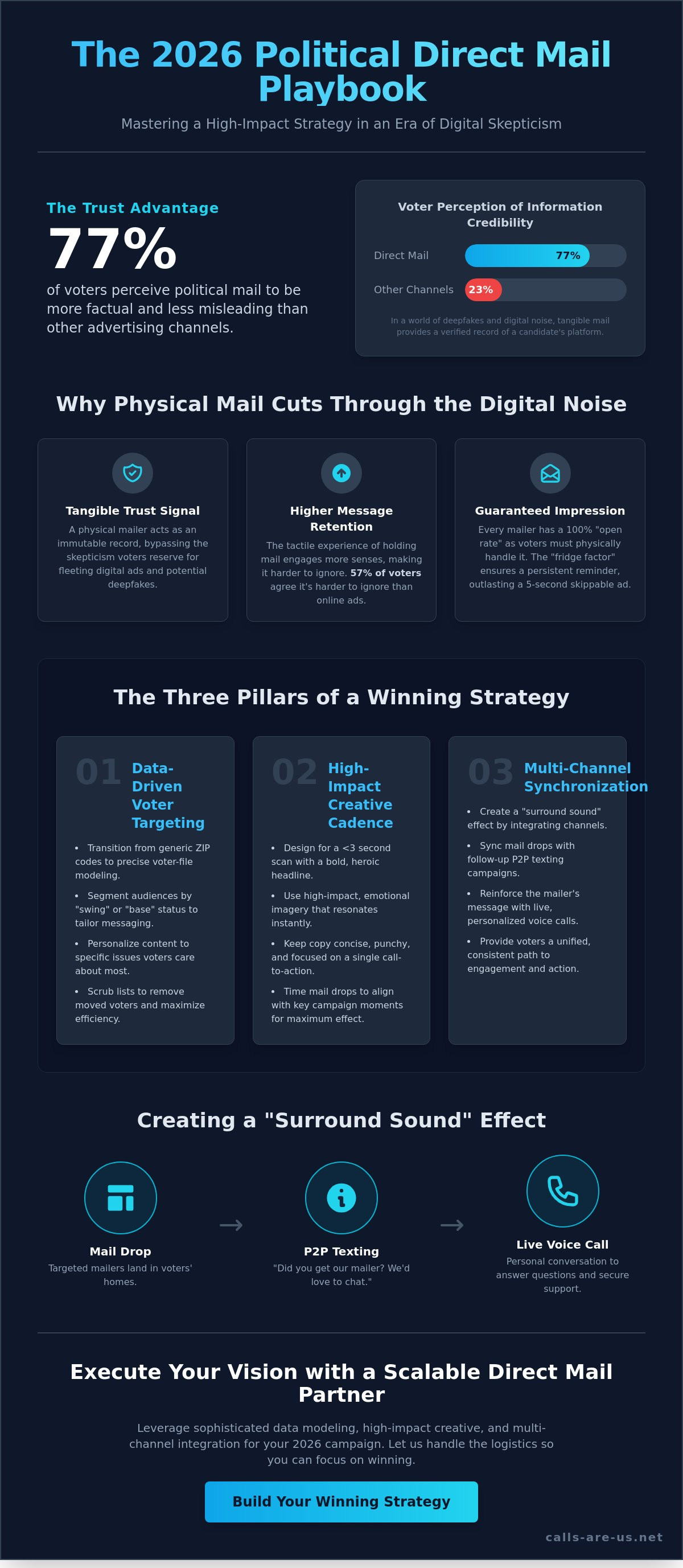
77% of voters now perceive political mail to be more factual and less likely to contain misleading information than other advertising channels. You've likely felt the diminishing returns of digital ad fatigue and the frustration of email response rates that barely register. It's a common challenge; as digital noise increases, the physical mailbox has become a sanctuary for credible communication. This guide will show you how to master a high-impact political direct mail strategy that serves as the physical anchor for your 2026 outreach. You'll learn to integrate tangible mailers with data-driven SMS and voice contact to build a sophisticated, multi-channel presence that voters trust. We'll examine the latest USPS regulations, analyze the precise timing for maximum persuasion, and break down how to synchronize your mailers with peer-to-peer texting and live calls for a unified path to victory.
Key Takeaways
Establish immediate voter trust by utilizing physical touchpoints that bypass digital skepticism and deepfake concerns.
Leverage data-driven precision to transition from broad zip-code mailers to individualized, voter-file targeting that speaks to specific concerns.
Integrate your outreach efforts to create a "surround sound" effect, synchronizing mail drops with peer-to-peer texting and live voice calls.
Master a comprehensive political direct mail strategy that balances high-impact creative design with the logistical rigor of modern campaign regulations.
Table of Contents
Why Political Direct Mail Remains the Foundation of Voter Trust in 2026
Architecting a Winning Political Direct Mail Strategy: The Three Pillars
Overcoming the "Digital-Only" Bias: Direct Mail’s Superior Persuasion Power
The Multi-Channel Synergy: Connecting Physical Mail to Voice and SMS
Executing Your Vision with Calls-Are-Us: Scalable Direct Mail Solutions
Why Political Direct Mail Remains the Foundation of Voter Trust in 2026
Trust is the ultimate campaign currency. A modern political direct mail strategy isn't merely about printing postcards; it's a sophisticated, physical communication plan designed to establish a tangible connection with voters. In an era where AI-generated deepfakes and digital misinformation saturate screens, a physical piece of mail serves as a verified, immutable record of a candidate's platform. It provides a sense of permanence that pixels simply cannot replicate. This physical presence acts as a trust signal, grounding your campaign in the real world while digital noise continues to escalate.
Voters are increasingly wary of what they see on their smartphones. Research from 2025 indicates that 77% of gubernatorial voters perceive political mail to be more factual and less likely to contain misleading information than other advertising channels. While a digital ad can be altered, spoofed, or deleted in an instant, a mailer remains a physical testament to a campaign's promises. It's delivered directly into the voter's private sanctuary, their home, where it bypasses the skepticism often reserved for social media algorithms.
To better understand how physical contact shapes voter perception, watch this helpful video:
The Psychology of the Mailbox
Checking the mail is a daily ritual. It's a moment of focused attention that stands in stark contrast to the mindless scrolling of social media. When a voter holds a high-quality postcard, they engage multiple senses, which significantly increases message retention and brand recall. This tactile experience fosters a human connection, establishes professional credibility, and creates a lasting impression. A post-2024 study found that 57% of voters described direct mail as harder to ignore than online or TV ads. By physically touching the message, the voter forms a cognitive link with the candidate that digital impressions can't match.
Cutting Through the 2026 Digital Noise
Digital channels are currently suffocating under the weight of rising costs and declining engagement. With CPMs on platforms like Meta rising by 20% year-over-year, the Political usage of direct mail offers a reliable, "clean channel" for persuasion. Every postcard effectively has a 100% "open rate" because the voter must handle the piece to sort it. A well-designed 6x11 oversized postcard often finds a home on a kitchen counter or a refrigerator. This "fridge factor" ensures your message serves as a persistent reminder for days. This longevity beats a five-second skip ad every time, ensuring your political direct mail strategy keeps your campaign top-of-mind until the ballot is cast.
Architecting a Winning Political Direct Mail Strategy: The Three Pillars
Precision wins elections. A high-impact political direct mail strategy relies on three non-negotiable pillars: data modeling, creative cadence, and logistical excellence. It's no longer enough to blanket a ZIP code with generic messaging. You must architect each drop to meet specific voter needs at the exact moment they're ready to decide. This structured approach ensures your campaign remains relevant, resonant, and remarkably efficient.
Data-Driven Voter Targeting
Stop guessing where your voters live. Modern campaigns use sophisticated voter file modeling to identify individuals by issue priority and voting propensity. You must scrub your lists to remove moved voters, segment your audience by their "swing" or "base" status, and personalize your messaging to match their specific concerns. Data from 2025 shows that 90% of gubernatorial voters want mail that speaks to them personally on the issues they care about most. If you need to scale these personalized efforts quickly, a specialized direct mail partner can help you manage complex data sets and fulfillment without losing your momentum.
Creative Best Practices for 2026
Design for the scan. Most voters decide to keep or toss a mailer in under three seconds, which means your headline must be the absolute hero of the piece. Use high-impact imagery that evokes an emotional response, but keep your copy concise and punchy. Every mailer should include a clear bridge to your digital presence, such as a QR code that triggers an automated SMS workflow or leads to a specific landing page. Your goal is to craft a single, powerful sentence that encapsulates your campaign's core promise and sticks in the voter's mind long after they've walked back from the mailbox.
USPS Logistics and the Red Tag Advantage
Timing is everything in a high-stakes election. The USPS offers specific USPS Political Mail services that include the "Red Tag" (Tag 57) system, which provides priority handling for political mailings. To maximize impact, you should coordinate your drops to hit mailboxes approximately 48 hours before early voting begins in your jurisdiction. You can also leverage Informed Delivery to put a digital preview of your mailer directly into the voter's email inbox on the day it arrives. This creates a powerful multi-touch experience before they even touch the physical paper.
Red Tag (Tag 57): Ensures your mail receives expedited processing during peak election seasons.
Informed Delivery: Generates a digital impression that reinforces your physical message.
Drop Cadence: Aligning your mail arrival with critical milestones like the start of absentee voting.
By treating your political direct mail strategy as a calculated architectural project, you transform a simple postcard into a powerful tool for persuasion. You aren't just sending mail; you're building a physical foundation for voter trust that digital ads can't undermine.
Overcoming the "Digital-Only" Bias: Direct Mail’s Superior Persuasion Power
Digital dominance is a persistent myth in modern campaigning. While many consultants assume younger voters are unreachable through their physical mailboxes, the data tells a different story. A balanced political direct mail strategy leverages the fact that physical mail now feels like a novelty to digital natives. It cuts through the white noise of a cluttered social media feed. It demands a physical interaction. It forces a moment of consideration that an unskippable YouTube ad rarely achieves.
The numbers reveal a stark contrast in engagement. Direct mail currently boasts an average response rate of 4.4%, which completely dwarfs the 0.12% average seen in email marketing. Digital ads are excellent for top-of-funnel awareness, but they often struggle at the critical stage of persuasion. When the stakes are high, voters look for official signals. Print provides that weight. Academic research on voter mobilization confirms that personalized, physical outreach remains one of the most effective tools for turning out the vote and shifting opinions in tight races.
The Cross-Generational Reach of Print
Gen Z and Millennials don't just ignore mail; they curate it. For a generation raised on ephemeral content, a well-designed postcard is a tangible artifact. You can tailor your design styles to reflect this by using bold typography, authentic imagery, and matte finishes that resonate with younger demographics. Because these voters receive fewer physical letters than previous generations, your mailer stands out as a significant event. It establishes presence, builds credibility, and facilitates a real-world connection that digital platforms cannot replicate.
Direct Mail vs. Digital Ad Fatigue
Screen exhaustion has reached a breaking point. Voters have developed "banner blindness," which is a psychological filter that allows them to ignore digital ads entirely. Direct mail bypasses this defense mechanism because it's less intrusive than a pop-up and more respectful of the voter's time. It's the perfect medium to reinforce messages already delivered through political voice broadcasting or peer-to-peer texting campaigns. This multi-layered approach ensures your campaign is heard, seen, and remembered without becoming a digital nuisance.
High-stakes persuasion requires a medium that voters take seriously. While digital ads are fleeting, a mailer is a physical commitment to a platform. It doesn't just ask for a click; it asks for a vote. By integrating mail into your 2026 outreach, you provide the authoritative "last word" that validates your entire digital presence.
The Multi-Channel Synergy: Connecting Physical Mail to Voice and SMS
Isolation is the enemy of impact. You shouldn't treat your 2026 outreach as a series of disconnected efforts. A sophisticated political direct mail strategy serves as the physical anchor for a broader, synchronized conversation. When you coordinate mail drops with digital follow-up, you create a "surround sound" effect that envelops the voter in your message. This multi-layered approach ensures your campaign isn't just seen once; it's reinforced, validated, and acted upon across the platforms voters use every day.
The Mail-to-Mobile Pipeline
Your mailer is a gateway to the smartphone. By placing a QR code prominently on an oversized postcard, you transform a static piece of paper into a trackable digital conversion point. This allows voters to opt into your campaign's ecosystem instantly. Once they scan, you can trigger an automated SMS workflow that delivers a video message, a volunteer sign-up, or a donation link. You can also deploy peer-to-peer texting to follow up on specific drops. A simple text asking, "Did you receive our mailer about local infrastructure?" transforms a one-way broadcast into a meaningful two-way dialogue. This level of coordination requires you to align your political direct mail costs with your digital spend to ensure every dollar drives a measurable action.
Coordinated Voice and Mail Campaigns
Voice outreach provides the human reinforcement that print alone cannot provide. A voice broadcast delivered shortly after a mailer hits the home creates a powerful "one-two punch" that significantly improves message recall. You can also use IVR polling to gather real-time feedback on your mailer's effectiveness, allowing you to adjust your strategy before the next drop. Maintaining a consistent mass communication strategy means the tone of your live calls must match the visual identity of your print pieces perfectly. This harmony builds the professional credibility needed to win in high-stakes environments. You must synchronize your timing, align your messaging, and track your conversions to achieve total campaign synergy.
Research indicates that voters who receive direct mail are 59% more likely to search for the candidate or issue online. By providing a clear path from the mailbox to the phone, you capture that interest before it fades. If you're ready to build a unified outreach engine, you can integrate your mail and mobile campaigns through our comprehensive outreach platform. This isn't just about sending mail; it's about facilitating a continuous relationship with the electorate that survives the digital noise of the 2026 cycle.
Executing Your Vision with Calls-Are-Us: Scalable Direct Mail Solutions
Execution is where strategy meets reality. A sophisticated political direct mail strategy requires more than just creative concepts; it demands a technical infrastructure capable of handling high-stakes fulfillment without friction. Calls-Are-Us provides the scalable solutions necessary to move your campaign from a digital blueprint to a physical presence in every target household. We combine the weight of a seasoned industry expert with the approachable partnership of a dedicated mentor, ensuring your outreach is both authoritative and human-centric.
Our live calling center serves as the vital human link in your multi-channel chain. While your mailers establish trust and provide detailed information, our professional agents provide the personal touch that converts awareness into action. This integrated approach allows you to follow up on specific mail drops with live conversations, answering voter questions in real time and reinforcing the core message of your campaign. By synchronizing these efforts, you create a seamless experience that respects the voter's time while maximizing your campaign's influence.
National Reach, Personal Impact
Scale should never come at the expense of integrity. We maintain the capacity to manage high-volume mail campaigns across all states, providing the logistical rigor needed for national organizations and local races alike. Our philosophy is rooted in advocacy and inclusive dialogue; we don't just provide a service, we champion a philosophy of ethical and effective communication. As an authoritative visionary in the outreach space, we utilize advanced operational workflows to ensure your mail arrives on time, every time, even as political mail volume continues to grow. With spending for the 2026 cycle projected to exceed 2022 midterms by more than 20%, having a partner that can navigate the increased demand is essential for maintaining your competitive edge.
Next Steps for Your 2026 Campaign
Efficiency is the byproduct of a unified strategy. Managing your voice broadcast, peer-to-peer texting, and direct mail through a single vendor eliminates the coordination gaps that often plague modern campaigns. This unity allows for faster deployment, consistent branding, and more accurate data tracking across every touchpoint. You can streamline your operations, amplify your message, and secure your victory by integrating your physical and digital outreach into one cohesive engine. The complexities of the 2026 landscape require a guide who is both technologically savvy and deeply committed to your success. You are invited to consult with Calls-Are-Us to build your 2026 outreach strategy and transform your vision into a winning reality.
Securing Your Path to Victory in 2026
The mailbox remains the only place where you have a voter's undivided attention without the interference of a digital algorithm. By implementing a data-driven political direct mail strategy, you establish a physical foundation of trust that fleeting online ads simply cannot erode. You've seen how tangible mailers, when synchronized with peer-to-peer texting and live voice calls, create a powerful "surround sound" effect that drives higher engagement. This multi-layered approach ensures your campaign is heard, seen, and remembered by the voters who determine the outcome of the race.
Success in the high-stakes 2026 cycle requires a partner who understands the technical and emotional nuances of modern outreach. Calls-Are-Us has operated in over 40 states, supporting national and local elections with a comprehensive suite of voice, text, and mail tools. Our seasoned experts navigate the complexities of regulatory compliance so you don't have to worry about the fine print. We're here to bridge the gap between technical excellence and human connection to help you unify your outreach, amplify your impact, and secure your victory.
You have the platform; we have the tools to deliver it. Master your multi-channel outreach with Calls-Are-Us and build the connections that turn voters into advocates. It's time to lead with confidence and win with precision. Your campaign's most impactful chapter begins today.
Frequently Asked Questions
How effective is direct mail for political campaigns in 2026?
Direct mail is exceptionally effective, boasting a 4.4% average response rate that completely dwarfs the 0.12% average seen in email marketing. In 2025, 67% of gubernatorial voters reported that physical mail impacted their opinion of candidates, which is a significant increase from previous cycles. This medium bypasses digital fatigue by providing a tangible, trusted message that voters are 57% more likely to find memorable than online advertisements.
What is the best time to send political direct mail before an election?
The most effective timeframe for sending mail is typically 3 to 4 weeks before an election. According to a 2024 survey of political consultants, this window allows for consistent name ID building before the final voting push. You should also time specific drops to arrive approximately 48 hours before early voting begins to ensure your platform is top-of-mind as voters receive their ballots.
Can direct mail be tracked for response rates?
Yes, you can track direct mail through several modern technical methods. Utilizing unique QR codes allows you to monitor digital conversions in real time, while USPS Informed Delivery provides data on how many voters viewed a digital preview of your piece. These tools transform a physical political direct mail strategy into a trackable, data-driven component of your total outreach ecosystem.
How do I integrate direct mail with my digital campaign strategy?
Integration works best by using mail as an anchor for your digital and mobile touchpoints. You can coordinate your mail drops with peer-to-peer texting or voice broadcasts to create a "surround sound" effect that reinforces your message across channels. Research shows voters who receive mail are 59% more likely to search for the candidate online, so your mailers should always lead directly to your website or SMS opt-in.
What are the USPS regulations for political mailers?
The USPS classifies political mail with a special red Tag 57 label to ensure priority handling during peak election seasons. Regulations also require specific sorting levels for discounted Marketing Mail rates, such as the 5-digit sort level for mailings of 500 pieces or more. You must also ensure your mail pieces comply with FEC disclaimer requirements, which mandate that all public communications clearly identify who paid for the piece.
Is direct mail more expensive than digital advertising for political campaigns?
While the cost per piece is higher than a single digital impression, direct mail is often more cost-effective on a per-conversion basis. Digital ad costs have risen significantly, with CPMs on major platforms increasing by 20% year-over-year. When you factor in the 100% "open rate" of a postcard and the high level of voter trust, the return on investment for mail often exceeds that of cluttered digital channels.
How do I choose between postcards and brochures for my campaign?
Choose your format based on your specific communication goal. Oversized 6x11 postcards are the gold standard for voter persuasion because the message is immediately visible and the visual impact is high. Brochures or letter packages are better suited for fundraising or detailed policy explanations where the voter needs more space to digest complex information and follow a specific call to action.
Does political direct mail require a specific union bug or disclaimer?
All political mailers must include a clear disclaimer identifying who paid for the communication as per FEC regulations. While a union bug is not a legal requirement, it is a strategic choice that can add 5% to 15% to printing costs. Including a union bug serves as a powerful trust signal for specific voter demographics, demonstrating your campaign's commitment to organized labor and local workers.



Comments