
Live Calls vs Voice Broadcast for Political Campaign Persuasion

A strong campaign phone strategy isn’t a choice between scale and conversation. Choosing live calls vs voice broadcast for campaigns means matching outreach to the voter’s next step: use a voice broadcast to deliver a consistent message at scale, live calls for personal persuasion, and live follow-up when someone responds or needs help. These approaches work best as connected parts of a strategy, not competing options.
Efficient outreach matters, but so does the human connection that can move a voter from hearing a message to engaging with it. Start by deciding what each contact should accomplish, then match the channel, message, and follow-up to that goal.
This guide explains when live calls, voice broadcasts, and live follow-up fit into a campaign’s persuasion strategy. It also covers how to coordinate phone outreach with other channels, shape a clear message, and create a practical path from broad outreach to meaningful conversations.
Table of Contents
Live transfer to a call center, legislator, or IVR
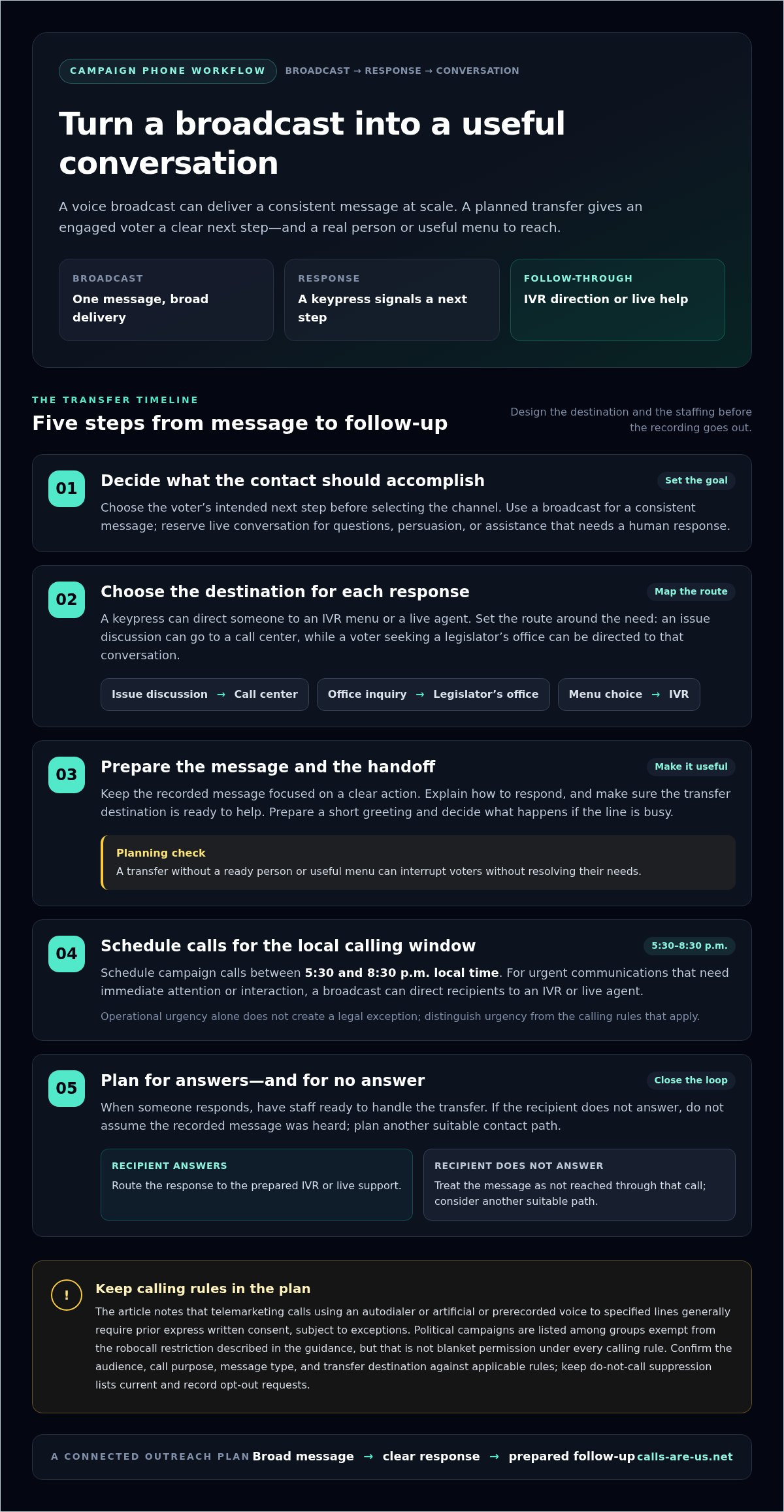
A transfer turns a one-way message into a next step. A voice broadcast can invite recipients to press a key, then route them to an IVR menu or a live agent. For example, a voter who wants to discuss an issue can be connected with a call center, while someone seeking a legislator’s office can be directed to that conversation.
Plan the destination before recording the message. Assign staff to answer, prepare a short greeting, and decide what happens if the line is busy. A transfer without a ready person or useful menu can interrupt voters without resolving their needs.
See how campaign phone banking gives volunteers a role in direct conversations with voters:
Virtual operations can widen the volunteer pool. Campaign platforms may let volunteers call from anywhere through a browser and support live monitoring, coaching, whisper guidance, barge functionality, and call transfers. These tools help a supervisor support a volunteer during a difficult exchange without turning every interaction into a scripted broadcast.
Call timing affects whether someone can answer. Schedule campaign calls between 5:30 and 8:30 p.m. local time. For urgent communications that require immediate attention or interaction, a voice broadcast can direct recipients to an IVR or live agent. Urgency alone does not create a legal exception, so campaign teams should distinguish operational urgency from applicable calling rules.
Delivery matters, too. A voice broadcast can deliver a recorded message, but recipients may not hear it if they do not answer. If they don’t pick up, the message hasn’t reached them through that call. Plan another suitable contact path rather than assuming everyone heard it.
What are the risks of using voice broadcasts for marketing campaigns? Recipients may not answer, and a poorly prepared transfer can leave them without help. Calling rules matter, too: telemarketing calls using an autodialer or artificial or prerecorded voice to specified lines generally require prior express written consent, subject to exceptions, according to the Office of the Federal Register, National Archives and Records Administration.
In the United States, voice-broadcast autodialers must comply with the Telephone Consumer Protection Act (TCPA). Political campaigns are listed among groups exempt from the robocall restriction described in the guidance, but that should not be treated as blanket permission under every calling rule. Keep internal do-not-call suppression lists current, record opt-out requests, and remove those numbers from future outreach. Before launching, confirm the audience, call purpose, message type, and transfer destination against the rules that apply.
Why Do Live Callers Outperform Robocalls and AI Voice for Persuasion?
Live calls give voters room to explain a concern and hear a relevant response. Automated broadcasts, by contrast, deliver a consistent message to an audience at the same time.
Comparing Calling Methods
A live call lets an agent listen, answer questions, and adapt the conversation. A recorded broadcast can reach hundreds or thousands of people at once, but it can’t respond to individual concerns. Manual agent calls offer a human exchange, while robocalls and AI voice rely on automation and scripted or generated speech.
Ringless voicemail serves a different purpose: recipients can listen later, making it suitable for non-urgent messages. Choose a broadcast when timely delivery or interaction matters, and voicemail when recipients can respond on their own schedule.
Response and Conversion Rates
There’s no single typical response or conversion rate for either method. Results depend on the audience, targeting, message, call timing, and whether recipients have a useful next step.
Measure the outcome that matches the campaign goal. For persuasion, track completed conversations and voter commitments. For a broadcast, track answers, IVR selections, transfers, and completed actions.
Human contact can matter when persuasion requires more than message delivery. Live phone conversations can increase voter turnout by 3 to 4 percent. That finding supports using live callers when the campaign needs to address voter questions or invite a specific commitment, rather than treating every contact as a simple announcement.
Automation can make outreach more efficient by sending the same recorded message to a large audience at once. A live calling team, by contrast, spends time on individual conversations. Compare channels by the work they need to do: automation suits broad delivery, while nuanced persuasion calls for agents who can listen and respond.
To set up and measure either campaign, define the desired action first, then select a channel and build a matching audience list. For live calls, record completed conversations and commitments; for broadcasts, track answers, IVR responses, and transfers. Compare results against the same campaign goal instead of treating every delivered call as persuasion.
Use a short broadcast with a clear action when scale matters, then reserve live calls for voters who need a conversation. If you’re planning a campaign around voice outreach options, match the channel to the response you want and the follow-through your team can provide.
Pre-recorded messages and text-to-speech
A recorded message gives every recipient the same prepared words, while text-to-speech turns written copy into spoken audio. Both approaches help campaigns deliver a consistent script, but neither can hear a voter’s question. Choose the format based on whether the goal is an announcement, a reminder, or a conversation that needs a live response.
Build the message around one action. For example, a campaign might invite listeners to attend a town hall, then provide the event details and next step. Keep the persuasion message to two or three core points. A short script is easier to follow, especially when recipients answer somewhere noisy or can listen only briefly.
Text-to-speech can make script changes easier: edit the text, review the spoken result, then use the approved version. Listen for names, place names, and abbreviations that a voice engine might mispronounce. A candidate’s surname or a street name can sound unclear even when the script looks polished. Have someone listen to the full recording before sending it.
Live agents add a human voice and can respond to what a voter says. During a call, an agent can explain a policy point, pause for a question, or clarify a meeting location. A recording can’t make those adjustments. Use live agents for dialogue and a prepared recording when the same accurate information needs to reach a broad audience.
Personalization should make the message relevant, not confusing. Create separate versions for distinct audience segments, such as one reminder for supporters and another for voters who requested event information. Keep each recording consistent, and verify that its details match the intended recipients. Avoid including personal details in audio unless there’s a clear reason and you can ensure each version reaches the right person.
For reminders, give the essential detail early. A listener who hears only the opening should still know whether the message concerns an election deadline, a public meeting, or a volunteer shift. State the action plainly, such as “confirm your attendance,” then repeat the key date or destination in the closing line. A clear call to action gives recipients a useful next step.
Before sending, use this simple review sequence:
Read the script aloud and remove words that sound stiff or crowded.
Confirm names, dates, event locations, and the requested action.
Listen to the final audio at normal speed and check that the message remains clear.
A reliable recording is more than polished audio. It gives listeners a focused message, accurate details, and one memorable next step.
How Should Persuasion Calling Integrate With the Rest of Your Campaign?
Make compliance part of the campaign plan, not a launch-day task. Before calling, define the campaign purpose, audience, dialing method, message type, and response path. These choices shape which requirements apply.
For telemarketing calls using an autodialer or an artificial or prerecorded voice to specified lines, prior express written consent is generally required, subject to exceptions, according to the Office of the Federal Register, National Archives and Records Administration. Live telemarketing calls and political outreach can involve different rules, so don’t assume one consent standard covers every call type.
Political campaigns are listed among groups exempt from the U.S. robocall restriction described in the research, but that exemption shouldn’t be treated as blanket permission under every applicable rule. The Telephone Consumer Protection Act (TCPA) still matters when planning voice-broadcast autodialing, and campaigns should account for other applicable requirements.
Separate call categories before building a list. A live agent speaking manually is different from an autodialed call using a prerecorded or artificial voice. For the latter calls to specified lines, apply the written-consent standard described above unless an exception applies. Keep consent records tied to the relevant number, purpose, and outreach method.
Caller ID, opt-out handling, and recording practices also need deliberate settings. Don’t assume one configuration works for live calls, prerecorded messages, and political outreach alike. Identify the campaign clearly, make an opt-out path understandable where appropriate, and document how the team handles requests. Review call recording separately, since requirements can depend on the call and applicable rules.
Use a repeatable pre-launch workflow:
Classify each call by purpose, technology, and intended recipient.
Match the audience list and consent records to that call type.
Set caller identification, opt-out handling, and recording procedures.
Test the script and response path before sending calls.
Record feedback and promptly suppress numbers with opt-out requests.
Campaign integration matters, too. If an email or text invites voters to request a phone conversation, carry that preference into the calling workflow. If a live call follows a digital interaction, give agents enough context to continue without repeating the entire pitch.
Review the process as targeting changes. Refresh audience and suppression data, check that scripts still match the campaign’s purpose, and keep records of consent and opt-out handling. A clear workflow helps teams coordinate political calling with other channels, protect voter trust, and make each interaction more relevant.
Blending automated calls with live follow-up
Automation can open the conversation, and live follow-up can move it forward. A campaign can send a recorded message to a broad audience, then direct voters who respond to an agent or a structured IVR path.
Design the handoff before launch. First, choose the broadcast’s purpose, such as a reminder or voter survey. Next, decide what each response means: a keypress might request a live conversation, register an answer, or indicate interest in an event. Finally, assign people to handle responses and give them the context needed for useful follow-up.
Scale is one reason to automate. Voice broadcasts can deliver information to hundreds or thousands of recipients simultaneously, while live agents focus on voters who ask for more detail. For example, a general election campaign could use a short recording to share a voting reminder, then route people seeking assistance to a live agent.
Interactive voice response can support reminders, rapid polling, and Get Out The Vote efforts. An IVR menu can collect structured answers, route voters to agents, and invite a small commitment, such as confirming an intention to vote. Arrange live follow-up for voters who need help rather than treating every menu response as a complete conversation.
Surveys can capture more than yes-or-no answers. Use an open-ended prompt when the campaign wants to hear voters’ concerns or motivations in their own words. Then review the responses and give callers useful feedback so their next conversations address what voters actually raised.
Automated outreach still requires careful targeting and compliance. In the United States, telemarketing calls using an autodialer or an artificial or prerecorded voice to specified lines generally require prior express written consent, subject to exceptions, according to the Office of the Federal Register, National Archives and Records Administration. Campaigns should also follow the TCPA and other applicable calling rules.
Keep the calling universe current. Update voter targeting weekly rather than relying on static lists for months, and schedule follow-up calls within days of major campaign events or advertising flights. This helps callers connect a recent message with a relevant conversation.
For U.S. calls, don’t use robocallers that store or generate phone numbers with a random or sequential number generator. Match each outreach method to its intended audience, maintain a process for opt-out requests, and ensure live staff can handle the responses the campaign invites.
Plan a coordinated voter outreach workflow that connects automated messages with live follow-up and clear response handling.
Calls-Are-Us: Voice Broadcast
Calls-Are-Us helps campaigns put a broad, consistent message in front of voters through Voice Broadcast. Use it to share a concise announcement or reminder with a large audience when individual conversations aren’t needed for every contact.
For a connected outreach plan, pair Voice Broadcast with a Live Calling Center for voters who need a personal conversation. Peer-to-peer texting and Mass Texting can support campaign communication through other direct channels. The right mix depends on the message, audience, and response you want to encourage.
Before launch, prepare the script, define the intended action, and plan how your team will handle responses. Visit Calls-Are-Us to discuss Voice Broadcast for your campaign.
Shape Your Next Campaign Around the Conversation
Start your next outreach decision with the voter’s experience. Decide what you want someone to understand, feel, or do, then build a clear path from the first message to meaningful engagement. The live calls vs voice broadcast for campaigns decision is most useful when it serves that larger purpose, rather than becoming a choice between tools in isolation.
Calls-Are-Us offers Voice Broadcast, Peer-to-peer texting, and Mass Texting to support campaign communication across direct channels. A thoughtful channel plan helps your team keep messages consistent while making room for voter interaction and response.
Bring your campaign goals, audience, and message priorities into the planning conversation. Contact Calls-Are-Us to discuss your campaign and explore an outreach approach that fits your next step. A focused plan can help your team communicate with clarity and invite voters into the conversation.
Frequently Asked Questions
How can I make mass phone calls?
Start by defining the audience, purpose, and response you want. Then prepare a contact list, choose live agents for individual conversations or a recorded broadcast for consistent large-scale delivery, and write a focused script. For example, a campaign could share a voting reminder and offer an IVR response option. Calls-Are-Us offers Voice Broadcast and a Live Calling Center for these outreach needs.
What is the difference between live call campaigns and voice broadcast campaigns?
Live calls connect voters with agents who can listen, answer questions, and adapt the conversation. A voice broadcast automatically dials a contact list and plays recorded audio, delivering the same message without a live exchange. Choose based on the interaction needed: a policy discussion calls for a person, while a uniform announcement can suit a broadcast. An IVR can collect keypad responses.
What are the typical costs per call for live calling versus voice broadcasting?
There isn’t one typical per-call cost that applies across campaigns. Live calling costs depend on factors such as agent time, call length, and the campaign’s workflow; broadcast costs depend on the outreach volume and message setup. Calls-Are-Us provides pricing after a quote request, based on the case. Compare costs alongside the outcome you need, such as a completed conversation or broad message delivery.
What campaign types are best suited to live calls versus voice broadcasts?
Use live calls for voter persuasion, polling conversations, and complex questions that benefit from a person’s response. Voice broadcasts suit consistent announcements, reminders, and broad outreach when the same message should reach a large audience. For example, a campaign might broadcast event information, then use agents to speak with voters who need more context. Match the method to the message and your capacity for follow-up.
What are the FCC rules for automated voice calls and prerecorded messages in the United States?
U.S. campaign calling must account for the TCPA and other applicable rules. Telemarketing calls using an autodialer or artificial or prerecorded voice to specified lines generally require prior express written consent, subject to exceptions, according to the Office of the Federal Register, National Archives and Records Administration. Political campaigns are listed among groups exempt from the robocall restriction described in the guidance, but that isn’t blanket permission under every rule.
What calling hours and do-not-call rules apply to campaign calls in the United States?
For campaign calling, schedule calls between 5:30 and 8:30 p.m. in the recipient’s local time zone. Keep campaign suppression lists current, record opt-out requests, and remove those numbers from future outreach. Political campaigns are listed among groups exempt from the U.S. robocall restriction described in the guidance, but teams should not treat that as permission to ignore other applicable calling rules or their own do-not-call requests.



Comments