
The Architect’s Guide to a Winning Voter Outreach Strategy in 2026

Updated: Jun 25
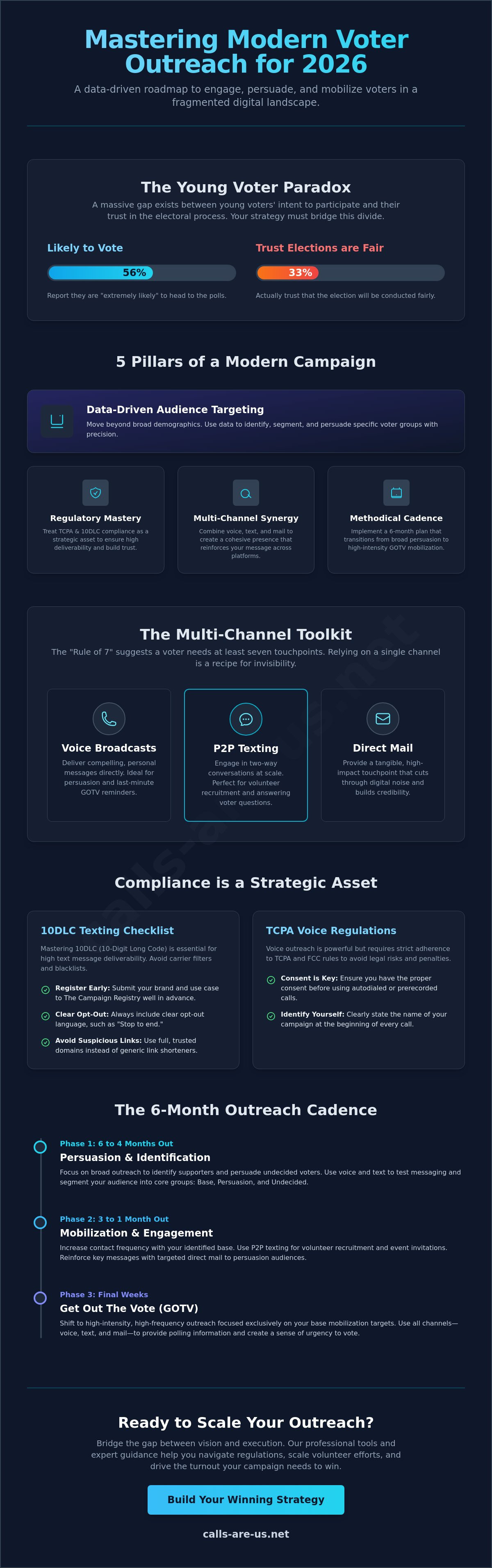
While 56% of young voters report they are extremely likely to head to the polls in 2026, only 33% actually trust that the election will be conducted fairly. This massive gap between intent and trust is where your voter outreach strategy must live. You've likely noticed that traditional methods are hitting a wall of silence. It's difficult to scale volunteer efforts when response rates are plummeting and complex 10DLC or TCPA regulations keep your team in a state of constant confusion.
We understand the stakes are higher than ever, and you need a partner who values integrity as much as efficiency. This guide will help you master the multi-channel tactics and high-tech tools required to engage, persuade, and mobilize voters in a fragmented environment. You're about to gain a clear roadmap for voter contact that ensures high deliverability for your texts and calls. We will explore how to bridge the trust gap, streamline your workflows, and ultimately drive the increased turnout your campaign requires to win.
Table of Contents
Defining the Modern Voter Outreach Strategy for 2026
Victory isn't accidental; it's engineered. A modern voter outreach strategy is a sophisticated, data-driven framework designed to identify, engage, and move specific target audiences toward a common goal. It's no longer enough to rely on organic social media posts or basic door-knocking. The 2026 landscape is defined by digital fragmentation, deep-seated skepticism, and a voter base that demands more than just a soundbite. By treating outreach as a cohesive system rather than a series of chores, you empower your campaign to foster genuine connections at scale. This architecture transforms passive awareness into active support.
To better understand how to build this foundation, watch this helpful video:
Competitive campaigns recognize that engagement is not a passive survey of civic pride. It's a high-stakes effort to win hearts and minds in a crowded marketplace of ideas. This shift requires moving beyond the "one-size-fits-all" mentality of the past. It demands a vision that is both technologically savvy and deeply human. When every interaction is backed by data and delivered with integrity, you build the trust necessary to influence the outcome.
The Shift from Single-Channel to Multi-Channel Systems
Voters don't consume information in a vacuum. They move between text messages, voice broadcasts, and their physical mailboxes throughout the day. The "Rule of 7" suggests that a voter needs at least seven touchpoints before they internalize a message and feel compelled to act. Relying on a single channel is a recipe for invisibility in a noisy environment. An authoritative campaign avoids the trap of one-dimensional methods, choosing instead to build an ecosystem where different channels reinforce one another. This synergy ensures your message remains top-of-mind without becoming repetitive or intrusive.
Identifying and Segmenting Your Core Audience
Precision is the hallmark of a professional operation. You must distinguish between your base mobilization targets, persuasion targets, and undecided voters to ensure your resources are spent wisely. Data allows you to move beyond broad demographics to understand the specific economic anxieties or values driving each group. This level of detail is vital when crafting a voter persuasion script that resonates on a personal level. By segmenting your list with care, you ensure that Get Out the Vote (GOTV) efforts are focused exactly where they will have the most significant impact on election night.
Navigating the Regulatory Landscape: Compliance as a Strategy
Compliance is the bedrock of high-performance communication. Many campaign managers view regulatory requirements as bureaucratic hurdles, but in a professional voter outreach strategy, compliance is actually a strategic asset. Bypassing these rules doesn't just invite legal risk; it triggers carrier filters that silence your message before it ever reaches a voter's hand. When you prioritize ethical communication, you aren't just following the law. You're building a foundation of trust that protects your campaign's reputation and ensures your digital footprint remains clean. 10DLC is the industry standard for campaign text deliverability.
Mastering 10DLC and A2P Messaging Standards
Register early to win late. The 10DLC (10-Digit Long Code) ecosystem requires campaigns to register their brand and specific use cases with the Campaign Registry. This vetting process assigns a trust score to your campaign numbers, which directly influences how many messages you can send per day and how likely they are to be delivered. To maintain high deliverability, your team should adhere to a strict messaging checklist. Use clear opt-out language like "Stop to end," avoid suspicious link shorteners, and ensure your message content matches your registered use case. Clean messaging practices prevent your domain from being blacklisted and keep your lines of communication open when they matter most.
TCPA and FCC Voice Regulations for 2026
Voice outreach remains a powerful tool, provided you respect the boundaries of consent. Under TCPA regulations, autodialed or prerecorded political calls to wireless numbers require prior express consent, though manually dialed calls do not. It's vital to remember that all prerecorded messages must identify the initiating entity at the very beginning of the call. While political calls are exempt from the National Do Not Call (DNC) Registry, maintaining an internal opt-out list is essential for building rapport and avoiding friction. You can find excellent examples of how to structure these communications in a nonpartisan voter participation toolkit, which highlights the importance of transparency.
Navigating these nuances is easier when you understand the specific rules for political voice broadcasting. Ensure your calling windows stay between 8 a.m. and 9 p.m. in the recipient's local time zone to stay within legal and social norms. If you want to ensure your campaign is fully protected, consider working with a compliance-focused partner who can audit your workflows. High-stakes communication requires technical precision; when you master the rules, you gain the freedom to focus on your message rather than your delivery failures.
The Multi-Channel Toolkit: Voice, Text, and Mail Synergy
A winning voter outreach strategy thrives on synergy. It's not enough to simply send emails or hope a social media post goes viral. You need a multi-channel ecosystem that delivers speed, scale, and significance. Speed allows you to react to breaking news within minutes. Scale ensures your message reaches every corner of your district. Significance comes from the authoritative weight of a physical touchpoint or a direct conversation. When these channels work together, they reinforce your message and drive higher engagement than any single method could achieve alone.
The Power of Professional Voice Broadcasting and IVR
Voice creates an immediate, human connection. Interactive Voice Response (IVR) transforms a simple message into a sophisticated tool for instant data collection and polling. It allows you to gather real-time feedback from thousands of voters simultaneously. Voice broadcasting is particularly effective for rapid response efforts, such as counteracting late-breaking opposition narratives or providing emergency campaign updates. This technology enables you to deliver high-stakes messages with the weight of authority, ensuring your voice is the one voters hear when it matters most.
P2P vs. Mass Texting for Direct Engagement
Texting is the most direct way to reach a modern voter. You must choose between the high-volume speed of mass texting and the personal rapport of peer-to-peer (P2P) messaging. Mass texting is ideal for urgent alerts, event reminders, or "Vote Today" prompts. Conversely, P2P texting allows your team to engage in deep-dive persuasion, answering specific questions and building trust through a two-way dialogue. In 2026, professional platforms allow these workflows to integrate seamlessly through APIs, giving you the flexibility to switch between broad-scale alerts and individualized outreach as your strategy evolves.
Direct Mail as a Tangible Touchpoint
Physical mail remains a critical signal of authority. In a world of fleeting digital ads, a well-designed mailer stays on the kitchen table, serving as a constant reminder of your campaign's presence. Its true power lies in its synergy with other channels. For example, receiving a tangible mailer followed by a well-timed GOTV call significantly increases message retention and voter turnout. This multi-channel reinforcement ensures that your campaign is seen, heard, and remembered when it's time to cast a ballot.
Designing the Outreach Cadence: From Persuasion to GOTV
Timing is everything in a high-stakes campaign. A winning voter outreach strategy functions as a living document, evolving from broad education to surgical mobilization over a six-month period. You must act as the architect of the voter journey, moving individuals through three distinct psychological states: awareness, persuasion, and action. This methodical approach ensures your resources are deployed with maximum impact as deadlines approach. The GOTV sprint is the final 72-hour push for maximum turnout.
Phase 1: The Persuasion and Education Sprint
Identify your allies early to win late. During the first five months of your calendar, focus on live calling and P2P texting to gauge supporter leanings and address specific concerns. This is the period where you establish your campaign's voice and build the trust necessary for later mobilization. Utilize data gathered from IVR polls to refine your messaging; if voters express anxiety over healthcare costs, your scripts should pivot immediately to address that reality. For campaigns operating on a strict budget, focusing on cost effective voter outreach during this phase helps you preserve capital for the high-volume final weeks. This phase is about identifying, educating, and persuading your core audience through consistent, high-quality dialogue.
Phase 2: The Mobilization (GOTV) Final Push
Intensity must peak when the polls open. The final week requires a high-frequency cadence that leaves nothing to chance, as voters are often forming their final decisions in these high-pressure moments. We recommend a triangulation method to ensure your message breaks through the noise: start with a text alert to grab attention, follow up with a voice broadcast to provide essential polling location details, and finish with a live agent call to secure a firm commitment. Managing this level of volume requires the logistical precision and technical infrastructure of a political campaign call center that can scale instantly to handle thousands of concurrent interactions. When you synchronize these channels, you create a sense of urgency that transforms passive support into physical presence at the polling station.
Victory belongs to those who plan with precision and execute with passion. If you're ready to build a timeline that drives results, contact our team today to design a customized outreach cadence for your 2026 campaign.
Scaling Your Strategy with Calls-Are-Us Solutions
Execution is where vision meets reality. A sophisticated voter outreach strategy requires more than just good intentions; it demands an infrastructure capable of handling the immense pressures of a modern election. Calls-Are-Us acts as your professional partner, bridging the gap between high-level strategy and ground-level results. We provide the scalability, compliance expertise, and multi-channel integration necessary to ensure your message doesn't just go out, but actually lands. While our technology is world-class, its purpose remains fundamentally human. We believe that technology should facilitate, not replace, the rapport and trust needed to move a voter from "maybe" to "yes."
Just as technology empowers campaigns to reach voters more effectively, tools like Rezumi empower individuals within the political space to optimize their professional profiles and ensure their skills are recognized by modern hiring systems.
Why Professional Call Centers Outperform Volunteer Efforts
Reliability is the foundation of a winning ground game. Volunteers are the heart of any campaign, but they aren't always equipped for the technical rigors or the grueling pace of 2026. Professional live agents offer a level of script consistency and data accuracy that grassroots efforts often struggle to maintain. When a "message spike" occurs, perhaps following a high-profile debate or a sudden economic shift, volunteer teams can quickly become overwhelmed. Our professional centers are engineered to absorb these surges without a drop in quality or deliverability. As a seasoned expert that has navigated elections across more than 40 states, we bring an operational maturity that protects your campaign from common technical pitfalls and ensures every interaction is handled with professional polish.
Integrated Multi-Channel Delivery for 2026
Efficiency comes from consolidation. Managing separate vendors for voice broadcast, peer-to-peer texting, and direct mail creates friction and dangerous data silos. Calls-Are-Us manages these diverse channels from a single strategic hub, allowing for a unified approach to voter engagement. This integration provides the benefit of unified reporting, giving you a crystal-clear view of how voters are interacting with your campaign across all platforms. You can track which touchpoints are driving the most conversions and adjust your resources in real-time to maximize impact. This level of visibility is essential for making the fast-paced, data-driven decisions required in the final weeks of a race.
Victory is achieved by those who refuse to leave their communication to chance. If you're ready to scale your impact and secure a win, it's time to partner with a team that understands the high stakes of modern influence and ethical communication. Empower your campaign with Calls-Are-Us today and turn your strategic vision into a decisive electoral reality.
Master the Architecture of Victory
Winning an election in 2026 demands more than just effort; it requires an architectural approach to engagement. You've seen how a modern voter outreach strategy must be data-driven, multi-channel, and strictly compliant to break through the noise. By synchronizing voice broadcasts, P2P texting, and direct mail, you create a persistent presence that builds trust and drives action. Success isn't about reaching every voter once; it's about reaching the right voters with the right message at the exact moment they're ready to listen.
Calls-Are-Us brings the weight of a seasoned expert to your operation. We've operated in over 40 states, providing the scalable multi-channel infrastructure needed to handle the most intense campaign cycles. Our team manages the complexities of 10DLC and TCPA compliance so you don't have to worry about deliverability filters. Technology should always serve the human connection, and we're here to ensure your vision translates into a decisive victory. Launch your high-impact voter outreach strategy with Calls-Are-Us. The road to the polls is complex, but with a principled guide, your potential for impact is truly limitless.
Frequently Asked Questions
What is the most effective voter outreach strategy for small local elections?
The most effective voter outreach strategy for small local elections combines targeted personal contact with high-efficiency digital tools. Focus your resources on high-propensity voters while using peer-to-peer texting to build local rapport. This approach allows you to maintain a human-centric campaign without the massive overhead of a statewide operation, ensuring every interaction counts toward your final tally.
How do I ensure my campaign text messages are compliant with 10DLC regulations?
Ensuring 10DLC compliance requires registering your campaign brand and specific use cases with the Campaign Registry well before your launch date. You must also include clear opt-out instructions, such as "Stop to end," in every message and avoid using public link shorteners that carriers often flag as spam. These steps protect your deliverability and build trust with both carriers and recipients.
Can I use voice broadcasting for political persuasion calls?
You can use voice broadcasting for persuasion, provided you adhere to TCPA regulations and clearly identify the initiating entity at the start of the message. While automated calls to landlines are generally permitted, calls to wireless numbers require prior express consent. Many campaigns find voice broadcasts most effective for delivering high-stakes updates or reinforcing mailers rather than cold persuasion.
What is the difference between P2P texting and mass broadcast texting?
Peer-to-peer (P2P) texting involves a live agent sending messages individually, which allows for two-way dialogue and higher engagement. Mass broadcast texting is a one-to-many tool used for rapid alerts and event reminders. While mass texting offers unmatched speed for logistics, P2P is the superior choice for deep-dive persuasion and building meaningful voter rapport through personalized conversation.
How early should a campaign start its voter outreach strategy?
A professional voter outreach strategy should ideally launch at least six months before election day. This timeline provides enough space to build a data-driven foundation, refine your messaging through polling, and establish a consistent presence before the high-pressure GOTV phase begins. Starting early ensures your campaign isn't just reacting to the news cycle but is actively shaping the narrative.
How does direct mail integrate with a digital voter outreach plan?
Direct mail serves as a tangible anchor that reinforces your digital and voice communications. For maximum impact, time your mailers to arrive just before a follow-up text or call. This multi-channel approach increases message retention by providing a physical touchpoint that voters can revisit and keep on their kitchen tables long after the digital interaction has ended.
What is the average response rate for political live agent calls compared to automated ones?
Live agent calls consistently achieve higher engagement rates because the human element is far more effective at overcoming skepticism. While automated tools are excellent for rapid-scale alerts and reminders, the nuance of a live conversation is better for securing firm voting commitments. Most campaigns use a blend of both to balance cost-efficiency with high-impact persuasion during the final weeks.
How can I increase voter turnout in low-engagement districts using technology?
Increasing turnout in low-engagement districts requires using technology to lower the barrier to participation and provide clear information. Interactive Voice Response (IVR) polls can help you identify specific community concerns, while P2P texting allows you to provide personalized voting information directly to a voter's phone. By using these tools to provide actionable guidance, you can transform disillusionment into concrete electoral action.



Comments