
Direct Mail for Nonprofits: The 2026 Guide to High-ROI Fundraising

Updated: Jun 18
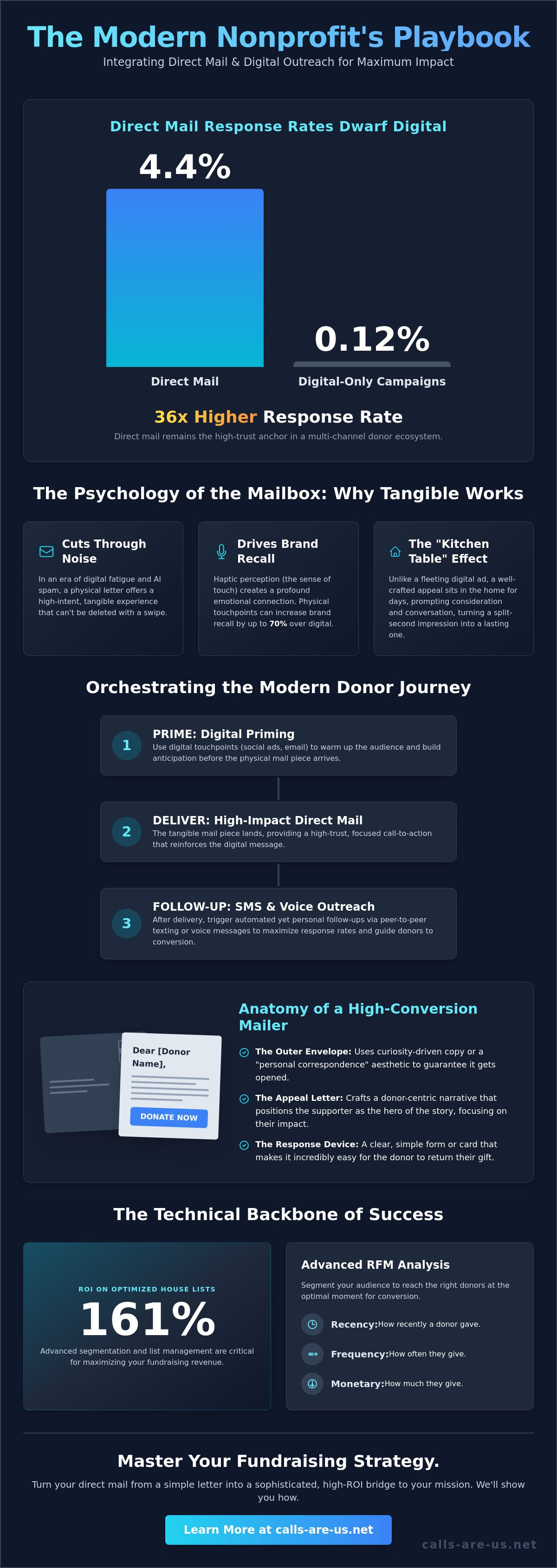
Direct mail for nonprofits currently generates a 4.4% response rate, a figure that dwarfs the 0.12% average seen in digital-only campaigns. It remains the high-trust anchor of a multi-channel donor ecosystem. You've likely noticed the tension between rising postage costs and the need for deeper donor connections. It's a constant challenge to balance the 2026 USPS rate increases with the necessity of reaching a donor base that still craves a physical touchpoint. We understand that you want a strategy that feels modern, stays scalable, and actually moves the needle on gift sizes.
This guide provides the roadmap to mastering the art of integrating tangible mail with digital outreach to boost donor retention and maximize your fundraising revenue. We'll show you how to turn a simple letter into a sophisticated bridge to your mission. You'll learn how to leverage the 2026 Integrated Technology Promotion, sync your mailings with peer-to-peer texting, and use automated voice outreach to create a seamless donor journey. We'll break down the technical workflows for tracking offline conversions, optimizing house lists for a 161% ROI, and capturing the attention of a new generation through tactile innovation.
Key Takeaways
Craft donor-centric narratives that prioritize the supporter's impact, ensuring your physical appeals cut through the clutter of a saturated digital landscape.
Implement advanced RFM analysis to segment your audience, ensuring your direct mail for nonprofits reaches the right donors at the optimal moment for conversion.
Master a precise orchestration sequence that uses digital touchpoints to prime donors before mail arrives and follows up after delivery to maximize response rates.
Evaluate fulfillment partners based on total cost of ownership and the strategic value of a "Union Bug" for building trust with advocacy-minded demographics.
Build a scalable stewardship ecosystem that integrates tactile mail with mobile outreach to increase average gift sizes and secure long-term donor loyalty.
Table of Contents
Why Direct Mail Remains the Anchor of Nonprofit Fundraising in 2026
Digital fatigue is a measurable reality for donors in 2026. While an email inbox is often a source of stress and automated clutter, the physical mailbox remains a space of high-intent interaction. Direct mail for nonprofits cuts through this digital noise by offering a tangible, sensory experience that cannot be deleted with a single swipe. This medium establishes a unique trust gap between your organization and the donor. In an era where AI-generated digital spam has eroded online credibility, a physical letter serves as a verifiable, high-trust anchor for your mission. It establishes credibility, fosters connection, and drives action in ways that pixels simply cannot match.
The numbers tell a clear story of performance. The average direct mail response rate is 4.4%, which significantly outperforms the 0.12% response rate typical of email campaigns. Direct mail fundraising provides a foundational method for organizations to speak directly to supporters without the interference of algorithms or filters. For major gift prospects, particularly those in the 64-year-old average donor demographic, receiving a physical package is a sign of respect and professional stewardship that digital outreach often lacks.
To better understand why this medium continues to dominate the fundraising landscape, watch this helpful video:
The Psychology of the Mailbox
Physical objects trigger deeper cognitive processing. Haptic perception, or the sense of touch, influences donor memory and creates a more profound emotional connection to your cause. This leads to the "kitchen table" effect. Unlike a digital ad that vanishes in seconds, a well-crafted appeal often sits in the home for days; it stays on the counter, moves to the desk, and eventually prompts a conversation. Physical touchpoints increase brand recall by up to 70% compared to digital-only outreach. When a donor holds your newsletter or appeal, they aren't just reading data; they're experiencing your mission in a three-dimensional format.
Direct Mail as a Long-Term Stewardship Tool
Mail is more than a tool for the "ask"; it's a vehicle for meaningful stewardship. You can use it for impact reporting, detailed thank-you notes, and legacy building. There is a strong correlation between physical mail and planned giving prospects. Major donors often prefer the permanence of a printed document when considering their long-term legacy or estate planning. By integrating your political direct mail strategy logic into nonprofit donor cycles, you can create a sense of urgency and community that digital channels rarely replicate. This approach turns a one-time donor into a lifelong partner through consistent, high-value physical touchpoints.
The Anatomy of a High-Conversion Nonprofit Direct Mail Piece
Every element of a physical mailing must serve a singular purpose: conversion. When designing direct mail for nonprofits, the architecture of the piece dictates the donor's journey from curiosity to contribution. It's a structured progression that requires the recipient to open the envelope, read the letter, and return the gift. If any single component fails to perform, the entire investment is compromised. High-ROI mailers in 2026 rely on a strategic blend of personalization, clarity, and ease of use to move a donor toward action.
The Outer Envelope is your first and most critical hurdle. If it looks like a generic solicitation, it ends up in the recycling bin before the seal is even broken. Successful organizations use curiosity-driven teaser copy or a clean "personal correspondence" aesthetic to ensure the piece is prioritized. Inside, your appeal letter shouldn't focus on your organization's internal needs. Instead, it must center the donor as the hero. Using effective strategies for nonprofits, you can craft a narrative that prioritizes "You" over "Us," showing the supporter exactly how their gift transforms lives. This donor-centric approach builds the emotional bridge necessary for a high-value response.
Friction is the enemy of generosity. The reply device should be intuitive, pre-filled with donor information where possible, and accompanied by a pre-addressed envelope. In 2026, integrating a QR code is a requirement for a modern campaign. It bridges the gap between the mailbox and your online donation page, allowing younger demographics to give instantly via their smartphones. To ensure these physical components are produced and dispatched with precision, many organizations choose to partner with a professional direct mail provider to handle the technical complexities of fulfillment.
Writing the Hook: The PS and the Headline
The P.S. is consistently the most read part of any fundraising letter. Donors often flip to the end to see who signed the piece and what the final "ask" entails. Use this space to reiterate urgency, mention a matching gift deadline, or provide a final emotional nudge. Headlines must be punchy, specific, and problem-oriented. You should guide the "skimming" reader by using bolding and underlining for key phrases. This technical formatting ensures that your core message is absorbed even if the donor only spends thirty seconds with the page.
Visual Design and Accessibility
Design choices should be driven by your donor demographics. Since the average donor is 64, prioritize accessibility by using at least a 12-point serif font and maintaining high contrast. Authentic imagery of the individuals or environments you serve builds immediate organizational trust, whereas stock photos often feel cold and disconnected. Don't fear white space; it's a tool for clarity. Proper spacing prevents donor overwhelm and directs the eye toward your most important calls to action, making the reading experience feel like an invitation rather than a chore.
List Management and Segmentation: The Technical Backbone
Data is the fuel that powers every successful campaign. Direct mail for nonprofits relies on the precision of your list to ensure that your message reaches an audience primed for action. Your "House List" consists of individuals who already know and trust your mission; these donors represent your highest ROI, often reaching 161% for established organizations. In contrast, an "Acquisition List" focuses on identifying new prospects through demographic and psychographic modeling. While acquisition costs are higher and immediate returns are lower, this strategy is vital for offsetting the 3.6% decline in individual donor participation reported in 2025.
Technical segmentation turns a raw database into a strategic asset. We utilize RFM analysis to categorize donors based on three critical metrics: Recency, Frequency, and Monetary value. This tripartite framework allows you to identify your most loyal advocates, your occasional supporters, and your high-capacity prospects. By employing variable data printing, you can move beyond generic "Dear Friend" greetings to create letters that reference specific past gifts and preferred programs. This level of personalization signals to the donor that you value their unique history with your cause.
Advanced Segmentation for Better ROI
Precision targeting prevents the "one-size-fits-all" trap that leads to donor fatigue. Lapsed donor reactivation requires special messaging for those who haven't given in 12 to 24 months, focusing on "we miss you" narratives rather than standard appeals. Tiered appeals are equally essential; you should match your "ask" amount to the donor's previous giving history to avoid under-asking major prospects. Data hygiene is the rigorous process of verifying and updating donor records to eliminate errors; it's a critical step to control waste and manage political direct mail costs by ensuring every piece reaches a valid address.
Suppression Lists and Cost Control
Profitability in direct mail is as much about who you don't mail as who you do. You must aggressively manage suppression lists to remove deceased donors and consolidate multiple-person households into a single mailing. This practice respects the donor's family and saves significantly on postage and printing. Maintaining a clean mailing preference center is an ethical necessity that builds long-term trust through transparent "Opt-Out" options. Finally, use "seed names"—internal addresses included in the list—to monitor USPS delivery times and ensure your mail is being handled according to your schedule.
How to Synchronize Direct Mail with SMS and Voice Outreach
Direct mail for nonprofits achieves its peak ROI when it's treated as part of a synchronized multi-channel ecosystem. Research indicates that 95% of marketers report that integrating physical mail with digital and mobile channels improves overall campaign performance. This synchronization transforms a passive reading experience into an active, multi-sensory dialogue. By layering mobile touchpoints around your mail delivery date, you can prime the donor's attention and provide immediate avenues for contribution.
Executing a high-yield synchronized campaign requires a disciplined five-step sequence:
Step 1: Send a "heads-up" text message 24 hours before the mail arrives to build anticipation and ensure the envelope is recognized.
Step 2: Time your voice broadcast to reach the donor three days after mail delivery to answer questions and provide a verbal call to action.
Step 3: Use P2P texting to follow up with donors who scanned your QR code but didn't complete their donation, offering a direct link to finalize the gift.
Step 4: Analyze multi-channel attribution to identify which specific touchpoint triggered the gift, allowing you to refine future outreach budgets.
Step 5: Automate "Thank You" calls or texts immediately upon receiving a gift to reinforce the donor's decision and begin the stewardship cycle.
This orchestrated approach ensures that your message remains top-of-mind. To implement these technical workflows with precision, sync your outreach today with our integrated communication platform.
The Role of Voice Broadcasting in Mail Campaigns
Voice outreach adds a human element to the technical precision of a mailer. You can apply political voice broadcasting techniques to nonprofit event reminders, ensuring high attendance for galas or town halls. Utilizing Interactive Voice Response (IVR) allows donors to process gifts directly through their phone's keypad, removing the need for a computer or a return envelope. Effective "warm-up" scripts focus on the impact of the upcoming letter, which can increase mail open rates by creating a sense of personal correspondence.
SMS Integration for Real-Time Engagement
Mobile messaging provides the immediacy that physical mail lacks. Including short codes on your mailers allows for "Text-to-Give" responses, capturing donations from supporters who prefer mobile wallets. Peer-to-peer (P2P) texting is particularly effective for handling specific donor objections or providing additional clarity on complex impact reports. A successful mass communication strategy ensures that your SMS, voice, and mail messaging are perfectly aligned, creating a unified brand voice that builds trust across every channel.
Choosing a Fulfillment Partner and Measuring Success
Execution determines the final ROI of any campaign. While the temptation to handle fulfillment in-house exists, the Total Cost of Ownership for DIY projects often exceeds the price of professional services. Direct mail for nonprofits involves complex logistics, from data processing and variable printing to postal sorting. A full-service mail house manages these technical workflows, ensuring your appeals bypass the common errors that lead to wasted postage and undelivered pieces. They also navigate the intricacies of USPS nonprofit authorization, which is essential for accessing rates that are typically 40% to 50% lower than commercial mail.
Postage optimization is a primary driver of campaign health. In 2026, navigating the twice-yearly rate adjustments requires a partner who understands presort discounts and entry-point optimization. For instance, as of April 2026, utilizing Carrier Route Saturation can bring letter rates as low as $0.155 per piece, while Automation 5-Digit Letters started at $0.178. A strategic partner doesn't just print your letters; they engineer your mail stream to capture every possible discount, allowing you to reinvest those savings into higher frequency or broader acquisition lists.
The Union Advantage in Nonprofit Mailing
Credibility is often found in the smallest details. For labor-aligned or social justice organizations, the "Union Bug" is a non-negotiable symbol of ethical production. This small mark signals to your donor base that your organization practices the values it champions. It builds immediate trust with advocacy-minded demographics who prioritize fair labor standards in their own lives. To ensure your offline presence remains consistent, a political campaign call center can complement these mail house operations by providing a human voice to follow up on these high-integrity mailings.
KPIs for the Modern Direct Mail Campaign
Data-driven organizations look beyond simple response rates to measure impact. To understand true campaign health, you must analyze three core metrics: Net Revenue, Average Gift size, and the Cost Per Dollar Raised (CPDR). While Gross Revenue looks impressive on a report, Net Revenue accounts for the rising costs of production and postage, providing a realistic view of available funds. You should also utilize match-back analysis to identify "hidden" conversions, donors who received a mailer but chose to give online. This cross-channel attribution reveals that the Lifetime Value (LTV) of a direct mail donor often exceeds that of digital-only supporters, as physical touchpoints foster the long-term loyalty necessary for sustainable growth.
Building the Future of Donor Connection
Success in 2026 requires a shift from isolated tactics to integrated ecosystems. You've seen how a single envelope serves as the high-trust anchor for your entire fundraising strategy. By combining donor-centric narratives with rigorous list hygiene and real-time mobile touchpoints, you transform your outreach from a simple request into a meaningful relationship. Direct mail for nonprofits isn't a relic of the past; it's a sophisticated tool for organizations that value authenticity and measurable results. To see how citizen-led movements leverage engagement to drive change, discover Aux Armes Citoyens ! and their focus on democratic rights.
Your mission deserves a partner that can scale your vision with technical precision. We provide scalable outreach across 40+ states, offering integrated Voice, SMS, and Direct Mail solutions tailored for high-stakes advocacy. Our team brings deep expertise in nonprofit communication to help you navigate the complexities of modern fundraising. It's time to move beyond the digital noise and create connections that last. Launch your high-impact direct mail campaign with Calls-Are-Us today and start maximizing your impact. Your donors are waiting to hear from you.
Frequently Asked Questions
Is direct mail still effective for nonprofits in 2026?
Direct mail remains one of the most powerful tools in a fundraiser's arsenal because it offers a tactile engagement that digital channels can't replicate. In 2026, it serves as a high-trust anchor that cuts through the noise of AI-generated digital clutter. Statistics show that direct mail response rates average 4.4%, which is significantly higher than the 0.12% typically seen in email marketing. It's an essential medium for building long-term donor loyalty and securing larger average gift sizes.
How much does a direct mail campaign for nonprofits typically cost?
The total investment for a campaign depends on your mailing volume, design complexity, and the level of personalization required. Key cost drivers include creative development, list management, variable data printing, and postage. While we don't quote specific pricing here, nonprofits should focus on the "Total Cost of Ownership" by weighing the efficiency of a full-service mail house against the hidden expenses of staff time and potential errors in DIY fulfillment.
What is a good response rate for nonprofit direct mail?
A response rate of 4.4% is considered a strong benchmark for a well-executed campaign. However, performance often varies based on the list type; house lists featuring previous supporters can see response rates between 5% and 9%. When you use direct mail for nonprofits in coordination with SMS and voice outreach, you often see these numbers climb as multiple touchpoints reinforce your core message and drive higher engagement.
How do I track donations from a direct mail piece?
Tracking offline conversions is achieved through several technical bridges that connect the mailbox to your database. You can use unique QR codes, personalized URLs (PURLs), or dedicated "Text-to-Give" short codes to monitor digital responses triggered by physical mail. Additionally, match-back analysis allows you to compare your mailing list against your incoming donations to identify "hidden" conversions from donors who received your letter but gave through other channels.
Should nonprofits use a union printer for their direct mail?
Utilizing a union printer is highly recommended for organizations focused on social justice, labor rights, or advocacy. The "Union Bug" is a visible symbol of ethical production and fair labor standards that builds immediate trust with specific donor demographics. It signals that your organization practices the same values of inclusivity and community support that you champion in your mission, reinforcing your brand's integrity with every piece sent.
How often should a nonprofit send direct mail appeals?
Most successful organizations find that sending four to six major appeals per year maintains the ideal balance of visibility and donor respect. This frequency ensures your mission stays top-of-mind without causing "ask fatigue." It's vital to intersperse these solicitations with stewardship pieces, such as impact reports or thank-you cards, to ensure your communication cycle feels like a partnership rather than a series of transactions.
Can I combine direct mail with digital fundraising platforms?
Integration is the standard for high-ROI fundraising in 2026. You can sync your physical mailings with peer-to-peer texting, automated voice broadcasts, and coordinated social media campaigns to create a seamless donor journey. Research indicates that 95% of marketers see improved results when they integrate direct mail with digital channels, as it allows you to meet donors wherever they are most comfortable giving.
What are the USPS nonprofit postage rates for 2026?
As of April 26, 2026, USPS Marketing Mail nonprofit rates for Carrier Route Saturation letters start at $0.155 per piece. Automation 5-Digit letters are currently $0.178. You must plan for the scheduled rate changes effective July 12, 2026, which include an average 5.1% increase for Nonprofit Marketing Mail Auto Letters. Navigating these twice-yearly adjustments is easier when working with a partner who understands postage optimization and presort discounts.



Comments